MES is not disappearing. The market is maturing, and it is splitting into four distinct categories that reflect how different manufacturers address the same fundamental execution challenges. Before evaluating specific vendors, manufacturers need to understand which category fits their situation.
The term MES has been around since the early 1990s, and its definition has shifted from a technical middleware layer to a broad set of functions. Through ongoing research, vendor briefings, and conversations with manufacturers, LNS Research has identified four distinct approaches to manufacturing execution. Each category represents a different architecture and philosophy for solving the same problems: managing what to make, how to make it, getting the job done, handling exceptions, documenting results, and improving over time.
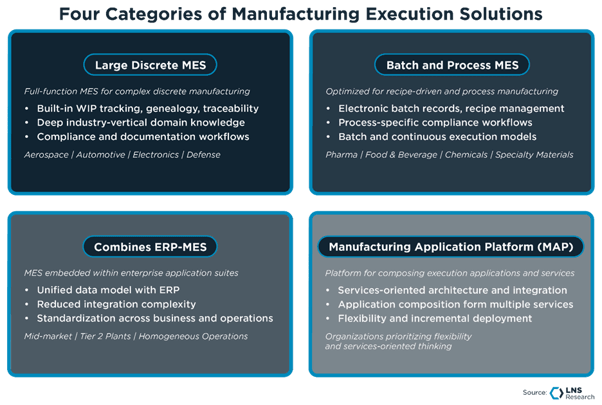
Full-function Manufacturing Execution Systems designed for complex discrete manufacturing. These systems provide built-in WIP tracking, genealogy, and traceability, and they align with specific industry verticals such as aerospace and defense, automotive, electronics, and similar environments with multi-step production and strict compliance requirements.
Vendors in this category have invested years in building domain knowledge into their products. For a large discrete manufacturer, the value proposition is clear: the system already understands your production model, regulatory environment, and industry nuances.
These solutions are optimized for recipe-driven, batch, and continuous process manufacturing. The execution model differs fundamentally from discrete manufacturing. Instead of tracking individual parts through work centers, these systems manage recipes, batches, and process parameters.
Pharmaceutical, food and beverage, chemical, and specialty materials manufacturers have regulatory and production requirements that general-purpose systems struggle to address. Electronic batch records, recipe management, and process-specific compliance workflows are the core reasons for implementing MES in these environments, not optional additions.
A growing segment delivers MES functionality tightly integrated with or embedded within an ERP platform. This approach works well for mid-market manufacturers and Tier 2 plants within larger enterprises where the priority is a unified data model and reduced integration complexity.
The trade-off is typically less depth in manufacturing-specific functionality compared to dedicated MES. For operations where production complexity is moderate and the organization values standardization across business and operations systems, the simplicity of a single vendor stack can outweigh the functional gap.
The fourth category represents a fundamentally different approach. Manufacturing Application Platforms do not deliver traditional MES capabilities as built-in application features. Instead, they provide a development and integration platform on which manufacturers or implementers build, configure, and connect applications that address the same execution challenges.
This distinction matters. A MAP is not a lesser version of MES, and MES is not a better version of MAP. They solve similar problems in different ways. Where a traditional MES provides WIP tracking and production management as pre-built functionality, a MAP provides the tools to create those capabilities through application composition and integration.
MAPs appeal to manufacturers who prioritize flexibility and a services-oriented architecture. Rather than adopting a vendor’s prescribed application structure, these organizations want to compose their execution environment from multiple services, building incrementally and retaining control over the application logic. The rapid advancement of AI is making this approach more accessible, as operations-focused teams can increasingly build what once required dedicated software engineering resources.
However, manufacturers considering a MAP should understand the implications. They are taking on responsibility for the application layer, including its design, testing, validation, and maintenance. The platform vendor provides the foundation, but the execution logic is yours to build and manage.
The right choice depends on several factors:
Manufacturing complexity and type. Discrete manufacturers with complex multi-step production and strict regulatory requirements will typically need a Large Discrete MES. Recipe-driven operations should look at Batch and Process MES. Simpler operations with a strong desire for enterprise integration may find Combined ERP-MES sufficient. Manufacturers that value flexibility are often best served with a MAP.
Industry-specific requirements. Regulated industries such as pharmaceutical manufacturing and aerospace have compliance requirements that dedicated MES vendors have embedded into their products over the years. Building compliance into custom applications on a platform is possible but carries more risk.
Integration strategy. If your priority is to implement ERP and MES simultaneously in a medium-scale operation, Combined ERP-MES may be the natural fit. If your priority is best-of-breed execution with open integration to multiple enterprise systems, dedicated MES or MAP may be more appropriate.
What Comes Next
LNS Research will be evaluating vendors across all four categories as part of our 2026/2027 MES Solution Selection Matrix program. Each category will be assessed independently, because comparing a dedicated Batch MES to a Manufacturing Application Platform on the same criteria would not produce useful guidance for manufacturers.
The manufacturing execution market is maturing, not dying. The emergence of four distinct categories reflects the reality that manufacturers have different needs, capabilities, and strategies. Understanding where you fit is the first step toward making the right choice.