The Industrial AI technology landscape is diverse, fragmented, and often difficult to navigate. At a time when almost every industrial technology company is an Industrial AI company and every AI feature is an Agent, the momentum is creating more confusion than clarity. Adding to the complexity, vendors do not always compete head-to-head or at the same level in the organization, making direct comparisons for manufacturing buyers difficult.
To help manufacturing leaders navigate this complexity, LNS Research has developed a framework that categorizes the Industrial AI market into distinct segments based on scope, architecture, and use cases. This blog will introduce the Industrial AI market landscape framework and provide details on several subcategories and their vendors.
What is Industrial AI?
LNS Research defines Industrial AI as the application of a range of Artificial Intelligence algorithms, models, and techniques, including machine learning, data-driven, and reasoning models, in conjunction with first principles, rules-based statistical methods, and other analytical approaches to solve industrial problems across the value chain.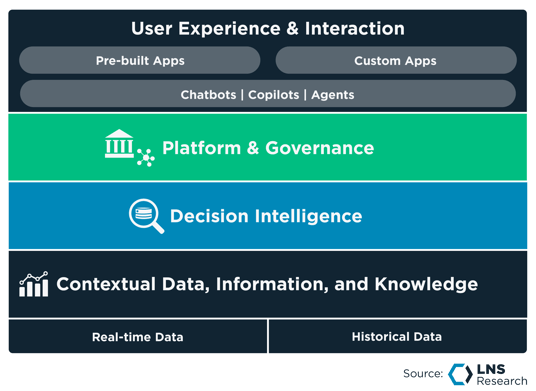
Industrial AI brings together Advanced Analytics and Decision Intelligence frameworks through pre-built applications, enables custom applications through no-code/low-code and prompt-based development, and orchestrates a continuum of Chatbots, Copilots, and Agents. It encompasses everything from first-principles models to machine learning and emerging causal reasoning models. The agentic layer focuses on how insights are consumed and acted upon through intelligent assistants that learn and improve over time.
The Industrial AI Market Landscape:
The Industrial AI Market Landscape (below) follows a layered architecture loosely aligned with the ISA-95 hierarchy. Industrial DataOps sits at the foundation - the data infrastructure layer that connects to plant floor systems and prepares data for consumption. Above this foundation, the middle layer contains specialized point solutions relatively close to day-to-day operations, organized by use case: Asset Optimization, Process Optimization, Physical AI, and Machine Vision. Above this layer, we have the higher-level categories: Advanced Analytics and the emerging Agentic Operations, each addressing specific operational needs.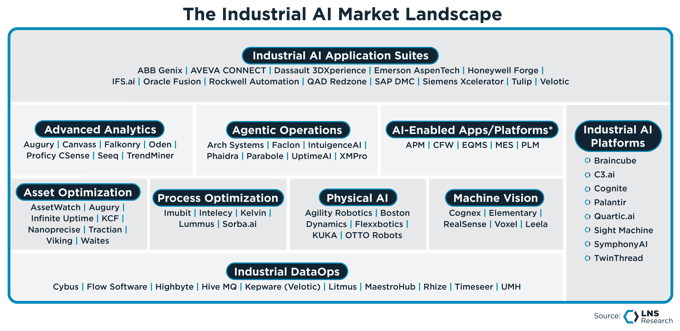
Industrial AI Platforms represent full-stack solutions that span vertically from DataOps through the analytics layer, offering integrated capabilities across all three tiers: data infrastructure, data platform/modeling, and decision intelligence applications.
Finally, the Industrial AI Application Suites at the top horizontal layer include major vendors that span across nearly all boxes, representing comprehensive enterprise offerings that touch DataOps, multiple use case categories, and platform capabilities. These suites provide end-to-end coverage across the supply network rather than focusing on a single layer or use case. Let’s take a closer look at each of the categories mentioned above.
Industrial DataOps
Industrial DataOps is an emerging discipline that unlocks the value of industrial data through connectivity, interoperability, contextualization, and modeling of data flow across industrial environments. Built on the principles of DevOps, Agile, and Lean, it is both a methodology and an enabling capability set that streamlines industrial data collection, transformation, contextualization, and orchestration across manufacturing environments.
Industrial DataOps bridges the persistent IT/OT gap by standardizing how data is managed and deployed across multiple use cases, sites, and initiatives. As Industrial AI emerges, DataOps naturally becomes the backbone of AI-driven autonomous manufacturing.
Industrial DataOps Vendors:
- Cybus
- Flow Software
- Highbyte
- HiveMQ
- Litmus
- MaestroHub
- Rhize
- Timeseer
- TPG Kepware
- United Manufacturing Hub
Industrial AI Platforms
Industrial AI Platforms are full-stack, industrial-grade software platforms designed to enable manufacturers to deploy AI at scale across a wide range of use cases. Unlike point solutions, these platforms provide integrated capabilities across three core layers: Industrial DataOps, Data Platforms (including Digital Twins and governance), and Advanced Industrial Analytics.
These platforms support the end-to-end lifecycle of Industrial AI - from industrial connectivity and contextual data modeling, through governance and model development, to productionized analytics applications embedded into operations. End users can perform advanced analytics through pre-built applications and, in many cases, build custom applications through no-code/low-code environments.
Industrial AI Platform Providers:
- Braincube
- C3.ai
- Cognite
- Palantir
- Quartic.ai
- Sight Machine
- SymphonyAI
- TwinThread
Advanced Analytics
Advanced Analytics solutions offer Decision Intelligence capabilities primarily through pre-built applications. These vendors provide data collection, analytics, and visualization functionalities as part of their applications but do not provide a licensable platform for end users to build custom applications. They employ a Wrap and Extend architecture approach, focusing on cross-functional use case coverage across assets, processes, material flow, energy efficiency, and workforce safety.
Advanced Analytics Vendors:
- Augury
- Canvass
- Falkonry
- Oden
- Proficy CSense
- Seeq
- TrendMiner
Industrial AI Application Suites
At the highest level of scope, Industrial AI Application Suites provide holistic coverage across the End-to-End Supply Network. This category includes large-scale enterprise software companies and automation providers who have assembled comprehensive Industrial AI capabilities through organic growth and acquisition. These vendors employ a Vendor Ecosystem architecture approach, delivering apps and platforms across the breadth of the value chain and extending scope beyond IT and OT to the entire supply network.
Industrial AI Application Suite Vendors:
- ABB Genix
- AVEVA CONNECT
- Dassault 3DXperience
- Emerson/AspenTech
- Honeywell Forge
- IFS.ai
- Oracle Fusion
- Rockwell Automation
- QAD|Redzone
- SAP DMC
- Siemens Xcelerator
- TPG (Kepware + ThingWorx + Proficy)
- Tulip
Asset Optimization
Asset Optimization solutions focus on optimizing asset health through condition monitoring, predictive and prescriptive maintenance, with a secondary focus on adjacent use cases, including process analytics, oil analysis, and energy optimization. Many vendors in this category use proprietary industrial-grade sensors combined with cloud-native platforms and services.
Asset Optimization Vendors:
- AssetWatch
- Augury
- Infinite Uptime
- KCF Technologies
- Nanoprecise
- Tractian
- Viking Analytics
- Waites
Process Optimization
Process Optimization solutions focus on process monitoring, analytics, and closed-loop process control capabilities, supplementing or replacing traditional Advanced Process Control (APC) systems. This category includes both emerging AI-first startups and legacy APC providers that have upgraded their platforms with modern AI capabilities.
Process Optimization Vendors:
- ABB
- AspenTech
- AVEVA
- Emerson
- Honeywell
- Imubit
- Intelecy
- Kelvin
- Lummus
- Rockwell Automation FT MPC
- Sorba.ai
Agentic Operations
Agentic Operations represents the next generation of Industrial AI - AI-native solutions focused on multi-agent orchestration, causal and reasoning systems to provide analytics intelligence and execution and control capabilities. These vendors are building decision intelligence from the ground up, using knowledge graphs, causal reasoning, and autonomous agents to move beyond dashboards and deliver measurable outcomes.
Agentic Operations Vendors:
- Arch Systems
- Faclon
- IntuigenceAI
- Phaidra
- Parabole
- UptimeAI
- XMPro
Machine Vision
Machine Vision applies AI-powered computer vision to industrial inspection, quality control, and visual analytics. These solutions use cameras, sensors, and deep learning algorithms to detect defects, verify assemblies, read codes, and identify anomalies at speeds and accuracy levels impossible for human inspectors.
What distinguishes modern AI-enabled Machine Vision from traditional rule-based systems is the ability to learn from examples rather than requiring explicit programming for every defect type - dramatically reducing setup time and enabling detection of subtle or previously undefined quality issues. As manufacturers face increasing pressure for zero defects and full traceability, Machine Vision has become essential infrastructure on the shop floor.
Machine Vision AI Vendors:
- Cognex
- Elementary
- RealSense
- Voxel
- Leela.ai
Physical AI
Physical AI represents the convergence of artificial intelligence with robotics and autonomous systems operating in the physical world. These solutions leverage advanced perception, navigation, and decision-making capabilities to perform material handling, logistics, and repetitive physical tasks traditionally done by humans.
Unlike traditional industrial robots that follow pre-programmed paths, Physical AI systems can adapt to dynamic environments, collaborate safely alongside workers, and learn from experience. As labor shortages intensify and manufacturers seek to automate non-value-added movement within facilities, Physical AI is emerging as a critical category - moving beyond the lab and onto factory floors at scale.
Physical AI Vendors:
- Agility Robotics
- Boston Dynamics
- Flexxbotics
- KUKA
- OTTO by Rockwell Automation.
AI-Enabled Applications and Platforms
Beyond these categories, traditional industrial software - including Asset Performance Management (APM), Manufacturing Execution Systems (MES), Enterprise Quality Management (EQMS), Product Lifecycle Management (PLM), and Connected Frontline Worker (CFW) solutions - has incorporated AI capabilities into its core offerings. These represent existing categories being enhanced with AI rather than AI-native solutions.
Summary & Recommendations
The Industrial AI market is expansive, dynamic, and - admittedly - confusing. With vendors approaching the space from different directions, overlapping categories, and a constant stream of new acronyms, it is easy for manufacturing leaders to feel overwhelmed. Here are some recommendations for industrial business and technology leaders to consider regarding Industrial AI:
- Don't do AI for AI’s sake: An Industrial AI and Advanced Analytics initiative, like any other strategic initiative, should be aligned with the company's overall business objectives. Understand your C-suite's objectives and build your Analytics strategy to deliver on those objectives.
- Predictive analytics is not the beginning or the end: Most companies in the early stages of IX maturity have much to gain from having data available and deploying predictive analytics. For companies a little ahead in their IX journey, there's a lot more to gain beyond predictive to prescriptive and prognostic capabilities, and build a closed-loop self-learning model.
- Plan top-down and execute bottom-up: A common mistake in industrial data initiatives is trying to fix every data source across the enterprise. Instead, start with a clear business problem, define the scope, identify user needs and required context, then execute from the ground up. True Industrial AI success requires leading with business outcomes and being supported by the necessary technology.