Continuous Improvement
C3 Transform 2023
According to C3 AI, “Generative AI Changes Everything.” Explore the next wave of AI innovation, how it's accelerating, and the challenges we foresee.

Software categories are nothing without some healthy competition, and it’s only more interesting when it’s a true 1-v-1 comparison of two companies with similar characteristics. Whether it was Seeq vs. TrendMiner in self-serviced Advanced Industrial Analytics, or more recently Highbyte vs. Litmus in Industrial DataOps, a closer look at each of these matchups provides some good insights on what it takes to win in a category.
Lately, I think there’s a similar story to tell about Palantir and C3.ai, two Industrial AI platform providers with meaningful overlap, but very different outcomes. Before going further, I want to clarify that this is not an attempt to punch down on C3.ai during what is admittedly a transition period for the company. (Full disclosure: C3.ai has been an LNS Research member in the past, and many end-user LNS Research members are customers of both C3 and Palantir)
The intent here, then, is to do a neutral, unbiased assessment of one of the most important technology categories in manufacturing today. The industrial productivity crisis is crippling manufacturing, and as many companies are looking to AI to solve these problems, it is important for us to understand what works and what doesn’t.
A Closer Look at the Industrial AI Platform Landscape:
Fifteen years into Industry 4.0, manufacturing still operates in one of the most heterogeneous and messy technology architectures of any sector. Fragmented data architectures span decades of investments, from legacy historians and SCADA systems to retrofitted MES systems, ERP platforms, data lakes/warehouses/lake houses, and modern cloud-native applications. The ISA-95 hierarchy was arguably the first approach to bring order to this complexity, but today's challenges go well beyond what that model envisioned.
Next came the Industrial IoT platforms. Platforms like GE's Predix, Uptake, and ThingWorx led with a compelling vision to connect and collect data, model it in a unified layer, and run analytics and build applications on top. But most had similar challenges around data contextualization, custom implementations, and time-to-value propositions that were not attractive. As a result, most of these first-generation Industrial IoT platforms are no longer in the market, at least in their original form. GE has split up, and Predix is gone. Uptake sold its manufacturing business, ThingWorx (which had the best data contextualization capabilities among the IIoT platforms with its Thing models), was recently sold to private equity firm TPG, which also picked up Kepware and GE's Proficy, seemingly positioning for a broader platform rollup.
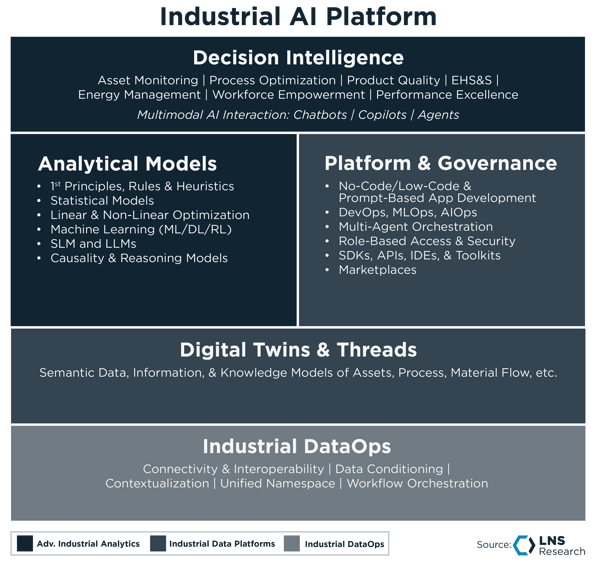
However, since then, a new wave of platforms has emerged, bringing together capabilities like connectivity, interoperability, conditioning & contextualization, data modeling, no-code/low-code environments, and a Decision Intelligence layer providing applications and analytics on top. This set of platforms, which LNS Research defines as Industrial AI platforms, is a class of full-stack, industrial-grade software platforms that provide integrated capabilities across three core layers — Industrial DataOps, Data Platforms, and Advanced Industrial Analytics.
These platforms enable manufacturers to connect to, collect, model industrial data, and deploy advanced analytics and AI at scale across a wide range of industrial use cases, from asset monitoring and process optimization within the factory to procurement, logistics, and field service across the supply network. We are currently drafting a Solution Selection Matrix report on the Industrial AI platform category, assessing the following companies:
Within this group, Braincube, Cognite, Quartic.ai, Sight Machine, and TwinThread form a natural cluster around industrial operations use cases, while C3.ai, Palantir, and SymphonyAI are positioned at a higher level, and span both industrial operations and supply chain across multiple verticals (although Cognite is increasingly reaching this level too). While SymphonyAI also fits into this discussion, especially considering its acquisition-led growth and IRIS platform, it’s followed a different path, so I’ll be focusing only on C3.ai and Palantir here.
A Quick Snapshot of Palantir and C3:
Palantir Technologies is a U.S.-based enterprise software company founded in 2003 and headquartered in Denver, Colorado, best known for building large-scale data and AI platforms that support operational decision-making in complex environments. On the other hand, C3.ai is an Industrial AI provider founded in 2009 and headquartered in Redwood City, California, offering a data platform and suite of pre-built AI applications spanning asset performance, supply chain, sustainability, and other domains.
On paper, both companies look remarkably similar in several aspects:
Both are enterprise-grade AI platforms spanning the core components of an Industrial AI platform: Industrial DataOps, data foundations, and advanced analytics.
Both have a significant presence across manufacturing and defense. Palantir is deeply embedded across several government agencies, while C3.ai has been used in areas like Air Force fleet management, with an increasing presence in state & federal agencies.
Both have meaningful connections to the fintech world: C3.ai has a presence in fraud detection, and Palantir’s ML tech has its roots in the pattern recognition work at PayPal.
Both take an “outside-in” view of manufacturing, spanning supply chain use cases alongside predictive maintenance, process monitoring, and knowledge management.
Both rely on service-intensive deployment models requiring significant custom implementation and vendor involvement.
Both face challenges tied to concentrated revenue among a smaller number of large customers, resulting in long sales cycles.
How and Where Palantir Won:
Despite these similarities, Palantir and C3.ai’s trajectories have diverged sharply in execution and customer impact over the past few years. On one side, Palantir has generated $4.475 billion in its latest annual revenue (56% up over 2024), with a market cap exceeding $400 billion. On its commercial business side, the company’s flagship products like Gotham, Foundry, and Apollo have been deployed in operational and supply chain use cases at companies like First Solar, Owens Corning, Heineken, L3Harris, Lear, and Merck.
On the other hand, C3.ai ended its latest fiscal year with $389 million in revenue. Over the past five years, C3.ai was ahead of the curve in generative AI with ambitious initiatives such as Enterprise Search as early as 2023, and has shown remarkable growth in pilots across manufacturing, financial services, and government. However, the company has not achieved the same level of impact at the scale as Palantir has had in recent years, nor has it consistently replicated value at the highest level across like it did with its flagship customers and partners, including Baker Hughes, Shell, Koch Industries, and Dow.
Over the past few months in particular, C3.ai has undergone notable leadership and operational changes, including a CEO transition and a significant workforce reduction. Combined with the latest earnings report that came in well below expectations, the company is in the midst of a broad reset as it works to stabilize its business in an increasingly crowded enterprise AI market.
To summarize, the delta here is not simply a matter of product capability: both platforms are technically sophisticated and enterprise-grade, but how each company operationalized its platform in customer environments, particularly in deployment model, architectural posture, and business execution. Let’s take a closer look at what specifically enabled Palantir to translate its platform into success at scale and achieve such dramatically different results.
Through initiatives like Warp Speed, FDEs quickly build pilots and workflows for use cases such as predictive maintenance, supply chain control towers, and production scheduling. What sets this approach apart from traditional consulting is its focus on speed and depth—delivering scalable value through rapid understanding, prototyping, and execution. Rather than relying solely on on-site expertise, the model enables deeper, more customized solutions and serves as a key differentiator from product-only Industrial AI platform providers.
Unlike many industrial platforms that remain constrained by the boundaries of existing IT and OT systems, Palantir’s model is designed to operate beyond them. Through its Forward Deployed Engineer approach, the ontology layer, and its focus on decision-layer architecture, Palantir can disrupt legacy processes and build AI-driven workflows and agents that circumvent the limitations of traditional ERP, MES, and historian-based environments. This deeper form of wrap-and-extend achieves two things at once: it enables more efficient, redesigned operational processes, and it allows Palantir to penetrate the customer’s architecture in a way that becomes highly sticky over time.
Summary & Recommendations:
Industrial AI platforms are an increasingly important part of the industrial technology stack. Deployed well, they can seriously make or break a manufacturing company's productivity goals.
Among the Industrial AI platforms LNS Research is currently assessing, Palantir currently leads the enterprise AI space in deal momentum, consistently landing large-scale industrial engagements at a pace that none of its competitors have matched. That said, its momentum isn't without its challenges. The Forward Deployed Engineer model is a key differentiator, but it's also expensive and can deepen dependency, making it a tough fit for mid-size manufacturers watching their budgets. And while the company’s commercial focus has made real inroads into commercial and industrial markets, its DNA is still rooted in government and defense, where the buying dynamics and operating realities look quite different. Foundry and AIP are powerful platforms, but that power comes with complexity that can be hard to absorb for organizations without deep data science and engineering bench strength.
I also want to reiterate that this post is not meant to diminish C3.ai, but rather to draw objective lessons from two different platform trajectories. The themes discussed here extend well beyond these two companies and reflect broader dynamics across the Industrial AI platform category, including long sales cycles, pilot-to-production challenges, and services-intensive deployments. So, what does all of this mean to COOs and business/technology leaders in industrial companies actively considering Industrial AI investments:

According to C3 AI, “Generative AI Changes Everything.” Explore the next wave of AI innovation, how it's accelerating, and the challenges we foresee.
Navigate the Industrial AI landscape with a framework covering DataOps, AI platforms, advanced analytics, and emerging agentic operations in...
2026 may be a turning point for Industrial AI. Explore three shifts shaping outcomes, AI agents, and time-to-value in manufacturing.