Metrics
Why Usage-Based Maintenance Is Still Preventive Maintenance
Learn about the differences between preventative maintenance and predictive maintenance.

Among the plethora of Industrial AI use cases today, predictive maintenance stands out as one of the most commonly implemented. Dating all the way back to World War II, when maintenance strategies were first developed for managing large fleets of assets and machinery, predictive maintenance has evolved dramatically with advancements in asset libraries, analytics, and now Artificial Intelligence.
In a way, it is now a foundational part of Industrial AI (and, in a way, to the future of manufacturing) because it is often the low-hanging fruit: the first line of use cases to be disrupted. Successful implementation of predictive maintenance solutions often lays the foundation for more complex use cases like quality, batch optimization, energy management, etc.
In this blog post, we will describe the evolution of predictive maintenance over the years and, in particular, discuss in detail the newest players on the block, the AI-first disruptors.
1. The Asset Performance Management Wave:
The first wave of predictive maintenance emerged in the early 2000s, closely tied to the rise of Asset Performance Management (APM) as a formal software category. At the time, traditional maintenance strategies - primarily time or condition-based approaches - were proving either ineffective, overly conservative, or too expensive. Manufacturers needed better ways, such as reliability-centered maintenance, to reduce unplanned downtime without over-maintaining equipment. 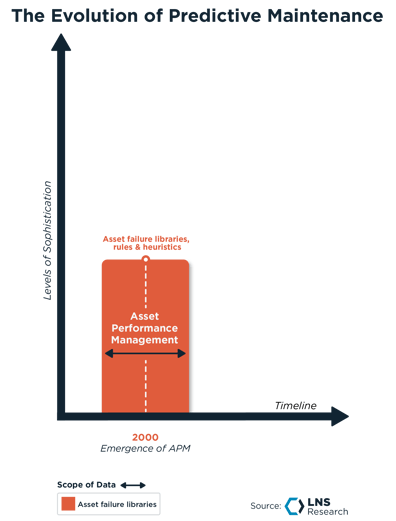
At the core of predictive maintenance during this era were asset failure libraries- comprehensive databases containing asset classes and components, failure modes, risk levels, failure criticality, and corrective actions. These systems were deterministic and rules-based, often built on decades of domain expertise and operational data. While they lacked the flexibility and adaptability of modern AI systems, they were successful in their time, especially in asset-intensive industries like oil & gas, power generation, and chemicals.
2. The Industries 4.0 and Advanced Industrial Analytics Wave:
Most of the 2000s saw the APM vendors achieve remarkable success with predictive maintenance, largely thanks to vast asset libraries and deterministic models. As Industry 4.0 accelerated data collection through sensors and historians, these deterministic approaches were no longer best-in-class. The rise of cloud and scalable compute enabled a new generation of startups that embraced a data-first model, building analytics on vast amounts of historical and real-time data. Unlike legacy systems, they shifted from deterministic rules to probabilistic models that combined machine learning with first-principles analysis. 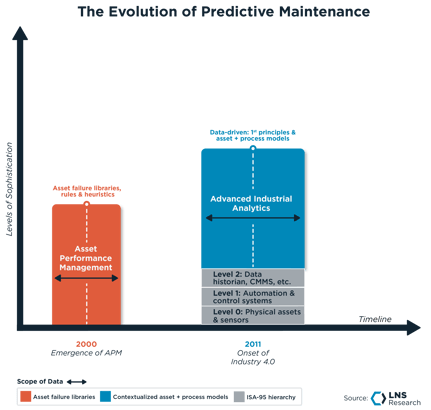
This disruption opened the door to an entire generation of industrial analytics vendors, many focused on point solutions such as OEE apps and self-service dashboards. A smaller group, however, advanced beyond this to deliver robust, data-driven predictive maintenance capabilities either through SaaS applications or part of a larger Industrial IoT platform. These Advanced Analytics vendors delivered next-generation capabilities that combined massive amounts of data with first-principles engineering, marking a clear evolution from the deterministic, library-driven methods of APM toward more flexible, probabilistic, and data-centric approaches.
However, these applications (and the machine learning models behind them) were still largely generic, built for pattern recognition that lacked the required tailoring to specific asset classes or manufacturing processes. The platforms themselves were also early-generation, overly complex, and often required heavy customization. Additionally, Industrial DataOps capabilities, such as connectivity and data contextualization, remained challenging, which meant that insights didn’t always arrive in time to drive meaningful action on the shop floor.
3. The Industrial AI Wave:
Just as advanced analytics–based predictive maintenance has moved beyond the limits of traditional rules-based models, Industrial AI has now established its own distinct approach. In recent years, a new wave of Industrial AI vendors focused on asset optimization has reshaped the predictive and prescriptive maintenance space, addressing many of the challenges that limited earlier Industry 4.0–era advanced analytics providers. 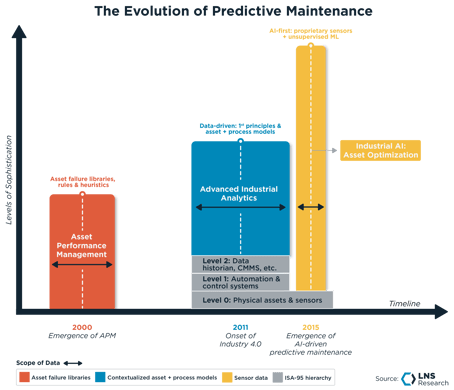
What set these next-gen disruptors apart were three key differentiators: proprietary sensors that bypassed the limitations of existing plant infrastructure; sophisticated, cloud-based AI models—such as unsupervised learning applied to vibration and temperature data—that improved continuously; and SaaS-based delivery models that paired software with services like field vibration experts and other SMEs. This combination created a large, fast-growing market, with vendors in this space generating more revenue and investment in five years than many earlier Advanced Analytics companies managed in a decade.
Some of the Industrial AI Asset Optimization companies that have secured a foothold and are disrupting predictive/prescriptive maintenance include (listed alphabetically):
AssetWatch provides a remote condition monitoring solution that integrates proprietary sensors, a cloud-based AI platform, and expert condition monitoring services into a full-stack offering. The system supports both continuous and route-based monitoring, enabling real-time insights into equipment health. AssetWatch also offers access to certified Condition Monitoring Engineers who help translate diagnostics into actionable maintenance strategies.
Augury, a pioneer in industrial AI for asset and process health, has achieved significant success with large-scale deployments across multiple verticals. Its Asset Health solution leverages AI to analyze vibration, acoustic, and thermal data for early detection of equipment issues. With the acquisition of Seebo, Augury expanded into Process Health—optimizing operations by balancing process constraints. The company continues to grow aggressively, introducing a variety of sensors (e.g., ultra-low frequency, pulse-based) and developing agentic AI capabilities.
InfiniteUptime is an AI-based predictive/prescriptive maintenance provider headquartered in India, focuses on heavy industries such as cement, metals, and tire manufacturing. The company differentiates itself with a hybrid sensor approach—using both MEMS and piezoelectric sensors—and by embedding AI directly in its edge devices. Powered by a large database of user-validated failure modes, it delivers high-accuracy diagnostics for both asset maintenance and energy optimization. With an “outcomes-as-a-service” model, Infinite Uptime goes beyond insights and guarantees results through closed-loop integrated workflows with customers.
KCF Technologies, founded in KCF Technologies (founded in 2000) is one of the two outliners having been in the predictive-maintenance space longer than most others. The company provides industrial machine-health monitoring systems using wireless sensors and analytics software. Their sensor-agnostic offering connects to existing hardware to track vibration, temperature, and other signals, enabling plants to shift from reactive to predictive maintenance and reduce unplanned downtime.
Nanoprecise is headquartered in Canada with a global footprint, serving industries like oil & gas, mining, and manufacturing with scalable AI-based predictive maintenance solutions. Its solution combines multi-parameter sensors with AI-driven analytics to detect early signs of equipment degradation. Its unique value lies in its energy-centric approach, going beyond traditional reliability monitoring to help organizations optimize energy consumption. This dual focus on reliability and efficiency sets it apart from competitors.
Tractian offers an integrated platform combining high-quality vibration and temperature sensors with a built-in CMMS (Computerized Maintenance Management System). This combination delivers predictive insights and actionable workflows, empowering maintenance teams to respond faster and more effectively. The company’s emphasis on sensor quality enhances diagnostic accuracy and operational efficiency.
Waites, founded in 2006 and headquartered in Cincinnati, Ohio, is the other outlier in this category. Although it lacks the momentum of venture-backed competitors, having been bootstrapped with no external investment, it has established itself as a reliable provider, especially in food & beverage and other mid-sized industrial facilities. Its key differentiator is a sensor-agnostic architecture that integrates proprietary wireless sensors with existing plant devices, enabling flexible, scalable deployments and lowering the barrier to continuous equipment health monitoring.
Overall, this new generation of Industrial-AI–first asset-optimization startups is increasingly displacing legacy solutions, delivering stronger growth and clear improvements over the previous wave. But they’re not alone in taking an Industrial AI-first approach to predictive maintenance. Large industrial companies have also strengthened their portfolios through acquisitions over the years, such as Senseye (now part of Siemens) and SmartSignal (acquired by GE Vernova). Finally, established Industrial AI platform providers have led with robust predictive and prescriptive maintenance capabilities as one among a suite of out-of-the-box applications (although some have been more successful than others).
Summary & Recommendations:
Predictive maintenance has long been seen as a “low-hanging fruit” for Industrial AI—delivering quick, measurable impact and often acting as a gateway to broader digital transformation. Over time, the space has evolved from traditional APM systems to advanced analytics, and now to AI-first companies focused on reducing key metrics like unplanned downtime and energy consumption.
These vendors have gained traction by offering integrated hardware, software, and services centered on asset performance. Their success is driven by direct access to real-time data, advanced machine learning models, and an ability to operate effectively without needing extensive historical failure data. As a result, many of these companies have achieved revenue, funding, and valuations on par with—or even exceeding—broader industrial analytics firms.
Additionally, not wanting to be left behind, CMMS and EAM vendors have also been rapidly innovating, with a new wave of AI-first providers rethinking how maintenance teams manage the asset lifecycle and maintenance management. Some of these newer entrants, such as MaintainX, Limble, Fiix (now Rockwell Automation), Prometheus, and Ultimo (now IFS), address long-standing usability, data quality, and workflow challenges while enabling more efficient scheduling, automated AI-powered insights, and improved productivity. We’re seeing the leading industrials are already closing the loop, linking asset reliability data to analytics and feeding those insights directly into their CMMS and EAM systems to create a truly Industrial-AI-ready maintenance strategy.
While the above profiled vendors are leaders in AI-based predictive maintenance, the space remains highly dynamic, with both AI-native startups and traditional condition monitoring companies actively competing. LNS Research will continue to track this evolving landscape as part of its broader Industrial AI research. Meanwhile, here are a few recommendations for manufacturing companies taking an AI-first approach for Predictive/Prescriptive Maintenance:
Evaluate Tradeoffs Between the Three Approaches: The framework above should not be interpreted as a “good–better–best” hierarchy. Pure-play APM, advanced analytics, and AI-first predictive maintenance each come with distinct advantages and limitations. The right choice depends on factors such as business objectives, asset types, scale, vendor lock-in considerations, the IT–OT relationship, etc.
Align Asset Optimization Strategy to Asset Type and Criticality: Most of these vendors specialize in rotating equipment like motors and pumps. While the critical ones might have a much easier ROI justification, not all assets require such advanced monitoring.
Congratulations. You have AI-first predictive/prescriptive maintenance. What Next? Predictive maintenance is a critical component of asset management, having evolved significantly from rules-based and first-principles approaches to advanced analytics and now Industrial AI, with predictions and prescriptive recommendations continually improving at each stage. Meanwhile, CMMS and EAM systems have also been advancing, reimagining how other facets of asset and maintenance operations are managed. There is a significant opportunity now to integrate these capabilities and apply AI across your entire asset strategy.
Learn about the differences between preventative maintenance and predictive maintenance.
Are maintenance professionals, including reliability engineers, about to go the way of blacksmiths? Digital Transformation makes it possible for IT...
Maintenance might not have been an issue with the recent fatal Germanwings crash, but when it is, impacts can be disastrous. Here's how to balance...