Most Chief Operating Officers (COOs) reading this will spend real money on an Intelligent Supply Network over the next three years. Most of them will not get the return they expect. The reason is rarely the technology. It is the set of assumptions leaders bring to the effort before the first contract is signed.
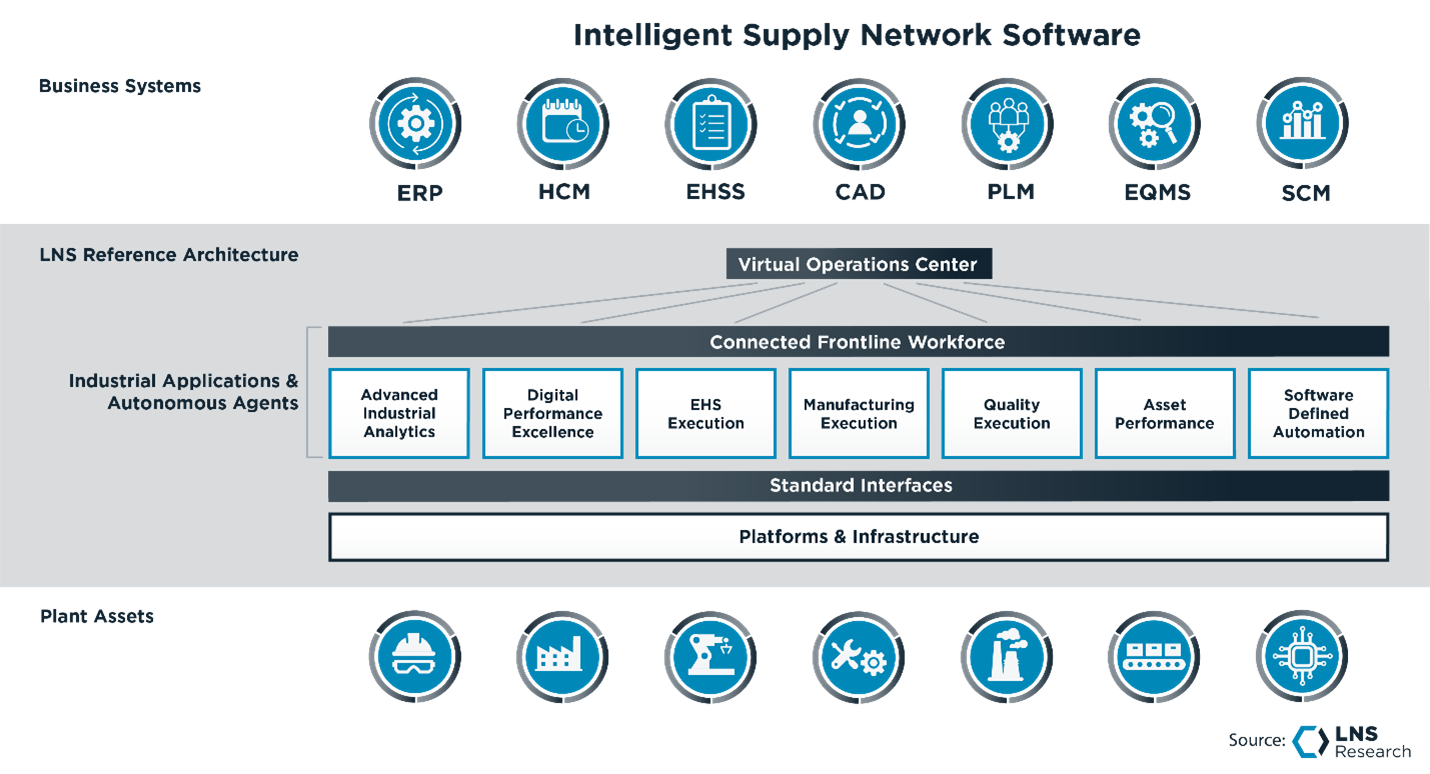
LNS Research defines an Intelligent Supply Network (ISN) as a set of established and future-looking technologies that – when deployed within an information-sharing architecture – enable the successful implementation of a company’s Industrial Operations Strategy across all its production plants.
Read that definition again and notice what it does not say.
It does not name a product. There is nothing to buy or subscribe to that’s called an ISN. It is an architecture for sharing information, populated by technologies you mostly already own.
That distinction is where most initiatives break. The point of an ISN is never the network itself. It is about executing your Industrial Operations Strategy across every plant, and companies that execute that strategy well pull away from those that do not. LNS Research’s data on Industrial Operations Strategy shows that leaders achieve:
36 percent higher operating margin
34 percent higher throughput
32 percent higher capacity utilization
22 percent higher uptime than followers
An ISN is the architecture that lets you execute at that level across every site. Build it on the wrong assumptions, and you do more than waste the investment. You stay among the followers while the gap compounds every year.
Here are the five ways we continually see these efforts fail.
1. You bought applications and called it a network
The common belief is that a better Manufacturing Execution System (MES), a stronger Asset Performance Management (APM) tool, or one more Industrial Internet of Things (IIoT) platform adds up to an intelligent network. It does not. You end up with better applications sitting in the same silos they always occupied, with no cross-plant intelligence connecting them.
An Intelligent Supply Network is defined by how information moves between your applications. The license count is beside the point. A plant can run modern, well-chosen software in every function and still be blind across the fence to the plant next door because the information never crosses. The intelligence lies in the connections, and the connections are exactly what a shopping list of products cannot deliver.
Hint to manufacturers: Judge your progress by how much information flows across plants and functions, not by how many applications you have deployed.
2. You mismanaged the pace and risk of change
Integration fatigue is real. Teams are worn down by years of customization and integration work, and the experienced people who understood the old systems are walking out the door. Two responses; both fail. One camp tears out everything at once and bets the operation on a single cutover. The other camp declares the current systems untouchable and changes nothing. Both are picking a doctrine instead of managing the change.
The right pace is the one the business needs, carried at a risk the business can defend. Your industrial software is the nervous system of your operation, and no one rips out a healthy nervous system to operate on a hand. But nobody keeps a failing one either. When a system is genuinely holding you back, replacing it is the responsible move, done deliberately and in the right order. Sometimes what you have is bad enough that ripping it out is the lower-risk path rather than the higher one. The failure mode has two faces: replacing more than the operation can absorb in one move and refusing to replace what is already costing you.
This is also why lighthouse plants fail to spread. They describe the destination in vivid detail but say nothing about the path, and a plant staring at a state it cannot reach in one jump often does nothing at all. Rather, give each site a sequence it can execute at a pace it can survive.
Hint to manufacturers: Size every change to the business need and defensible risk. Replace what is holding you back, keep what works, and take on no more change at once than the operation can absorb and recover from.
3. You standardized the plant floor
Once a company commits to scaling, the instinct is to push standardization down to the floor: identical equipment, common programmable logic controller (PLC) tag naming, one configuration in every plant. It rarely survives contact with reality, and a single acquisition resets the entire program.
The plants that succeeded did not standardize the equipment. They standardized the operations layer that sits above the equipment and left each plant the flexibility it needed to run. You transform with the plant, not for it. Business systems at the top, such as Enterprise Resource Planning (ERP), Product Lifecycle Management (PLM), Enterprise Quality Management (EQMS), and Supply Chain Management (SCM), can be standardized because the work they do is similar everywhere. Plant assets at the bottom are diverse and will stay that way. The real work is building the translation layer between the two, so operations look consistent to the business even when the equipment underneath it never will.
Hint to manufacturers: Standardize the operations layer above your equipment and let each plant keep the flexibility that makes it run.
4. You can’t see past your fence line
An ISN that stops at your own walls is not a network. Most companies see their own inventory and their direct suppliers clearly, and almost nothing past that. They cannot see a tier-2 supplier’s inventory drawing down or its quality drifting, nor can they see a customer’s inventory building while flow rates slow. Each of those is an early signal of a disruption; by the time it reaches the plant, the schedule is already fixed, and the cheap options are gone. You cannot optimize what you cannot see beyond your own fence line.
Seeing is only half the problem. A dashboard that surfaces a disruption you have no way to act on is an expensive way to arrive late. Visibility earns its keep only when it connects to a decision and an action somewhere in the network. Plenty of ISN programs deliver beautiful views of problems the organization is still structured to ignore.
Hint to manufacturers: Extend visibility upstream past your direct suppliers and wire every view to an owner who can act on it.
5. You let the agents run before you built the foundation
Agentic artificial intelligence (AI) is the part everyone wants to talk about. An agent does not just answer a question. It pursues a goal and takes action, which means an agent can change your systems, not only inform them. That is precisely why sequence matters more here than anywhere else in the program.
Deploy AI on top of a broken process, and it faithfully automates the break. An automated inspection deployment in a regulated setting resulted in a high false-negative reject rate because the underlying process was never corrected first. Data has the same dependency. A digital twin built to optimize inventory fails when there is no clean, standardized data pipeline to feed it. The agents assume a foundation that most companies have not yet poured.
Capability is not judgment. An agent optimizes the objective you hand it. It does not own the tradeoffs outside that objective, and it does not carry accountability for the result. Our ISN survey found that 29 percent of leaders would take humans out of the loop entirely, against 11 percent of followers. That readiness is earned through governance, not assumed. The agents are the easy part. Governing what runs unsupervised is the hard part.
Hint to manufacturers: Correct the process and the data first, then automate one decision at a time under human oversight.
Recommendations for Manufacturers
Start with your Industrial Operations Strategy.If you are assembling a product shortlist before you have written down what your operation is trying to become, you have the order reversed. The strategy determines which information must flow and why. The technology follows from that.
Standardize the operations layer above your equipment. Accept that plant assets are diverse and always will be. Put your standardization effort into the translation layer that makes operations legible to the business, and give each plant room to run.
Demand open interfaces from your vendors. Unifying information technology (IT) and operational technology (OT) requires open standards and published Application Programming Interfaces (APIs). Reward the software vendors who provide them and be skeptical of those who lock your information inside their products.
Correct the process and the data before you point AI at it. Automation applied to a broken process scales the break. Clean, standardized data and a corrected process are the price of admission for anything agentic.
Govern autonomy from the first agent. Decide what an agent is allowed to change, what stays under human review, and who is accountable when an optimized objective produces the wrong outcome. Build this before you turn anything loose, not after the first incident.
The companies pulling ahead are not the ones with the most applications. They built an architecture where information moves across plants and past the fence line, and they earned the right to automate one decision at a time. That path is learnable, and it is the difference between the leader margins above and slowly falling behind them.
Stay tuned to LNS Research… In my next blog in this series, I move from why these efforts fail to how to build an Intelligent Supply Network that works.
All entries in this Industrial Transformation blog represent the opinions of the authors based on their industry experience and their view of the information collected using the methods described in our Research Integrity. All product and company names are trademarks™ or registered® trademarks of their respective holders. Use of them does not imply any affiliation with or endorsement by them.
Discover how AI agents with guardrails enhance safety and efficiency in supply networks, ensuring responsible autonomy in industrial operations.
Niels Andersen
Jun 25, 2025
SUBSCRIBE TO THE LNS RESEARCH BLOG
Stay on top of the latest industrial transformation insights from our expert analysts
The Industrial Transformation and Operational Excellence Blog is an informal environment for our analysts to share thoughts and insights on a range of technology and business topics.