Welcome back to Survey Snippets, our ongoing series where we pull data points from LNS Research surveys and unpack the insights behind them. This edition draws from our recent Industrial AI research, a survey of around 200 business and technology decision-makers across manufacturing industries.
Specifically, we will be looking at the adoption rates for Industrial AI, as, on one hand, it is gaining measurable traction across manufacturing and operations, but the survey data reveals a persistent disconnect between how organizations characterize their AI posture and the functional depth of deployments on the ground. Let’s take a look.
The Perception: Industrial AI Adoption Shows Promising Results
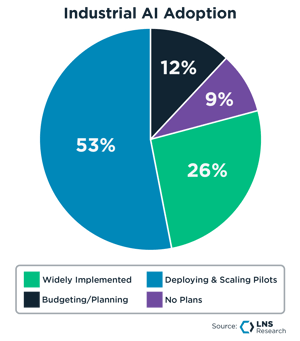 As you can see, the above survey data paints an optimistic picture of Industrial AI momentum: roughly one in four companies report widespread implementation, more than half are actively deploying and scaling pilots, and only nine percent have no plans at all. That means 91% of surveyed companies are already down the path with Industrial AI, which is a remarkable statistic by recent measures.
Taking a closer look, we find that the 53% in the pilot-and-scale phase tracks with what we're hearing in conversations with LNS Research members, The COO Council, and speakers at industry events. There is unprecedented end-user pull and deal momentum in this space.
But the 26% claiming "widely implemented" was the one that caught my attention. A quarter of the industry is already reaping the benefits of Industrial AI. That would imply widespread adoption of advanced capabilities – things like AI-driven process optimization, intelligent scheduling, predictive quality, or autonomous decision-making in operations.
That's not what we're hearing on the ground. What we're hearing is a lot of figuring out, including pilots, experimentation, and multi-site strategies for organizational readiness challenges, data infrastructure gaps, and plenty of enthusiasm, without a proportional level of scaled success to match the above data point claims.
So we asked a follow-up question: How are you positioning Industrial AI in your organization? Which brings us to the reality part of this…
The Reality: What “Widely Implemented” Actually Means
When we look specifically at the top 26% – the companies that claim to have widely implemented Industrial AI – and ask how they are positioning it, the picture becomes much clearer.
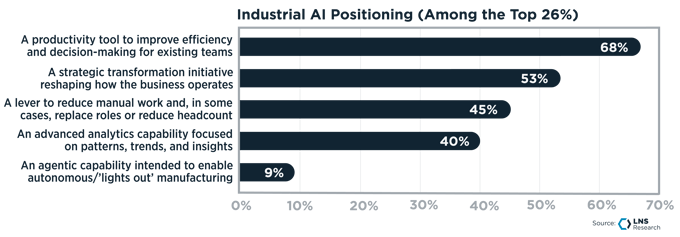
- 68% see it as a productivity tool to improve efficiency and decision-making for existing teams. This is the dominant way manufacturers position Industrial AI. This includes the ChatGPT-style chat interfaces layered on top of an enterprise LLM – summarizing documents, drafting emails, answering questions from internal knowledge bases. While there are significant levels of productivity gains from these tools, this is a far cry from what most of us would consider a transformative application of Industrial AI.
- 53% are treating it as a strategic transformation initiative, reshaping how the business operates. This is a meaningful and growing segment. An increasing number of COOs are standing up dedicated Industrial AI programs – notably, these are business-led initiatives with executive sponsorship, not just smart manufacturing team projects tucked inside engineering. This signals maturity in the way organizations approach AI governance and change management.
- 45% are positioning it as a lever to reduce manual work and, in some cases, replace roles or reduce headcount. Using cost reduction as the primary incentive for transformation is rarely the right approach. That said, context matters. LNS Research's productivity research shows that in certain industries, productivity gains can legitimately be achieved by producing less output with proportionally less input.
- 40% view it as an advanced analytics capability focused on patterns, trends, and insights. Essentially, an evolution of the analytics programs many manufacturers have been building for years, now augmented with AI/ML techniques.
- And finally, only 9% view Industrial AI as an agentic capability intended to enable autonomous or “lights out” manufacturing.
The Biggest Takeaway: Where Is Autonomous Manufacturing?
Fewer than one in ten companies – even among those claiming the widest implementation – are thinking about AI in the context of autonomous manufacturing. This is, in our view, the most significant finding in this data.
Now, let’s be clear: we’re not suggesting the industry should be rushing headlong into handing over large-scale manufacturing operations to AI agents. Autonomous decision-making in critical process control, safety-critical environments, and regulatory-heavy operations demands a level of reliability, explainability, and trust that we’re not yet equipped to deliver at scale.
But there is an enormous amount of runway between using AI to rewrite, spell-check, and summarize written content on one end and fully autonomous operations on the other. And that middle ground is where the real value creation is happening for early adopters.
At LNS Research, we’ve defined levels of autonomy for manufacturing – a framework that maps the progression from fully manual operations to fully autonomous ones. The key insight from this framework is that autonomy is not a binary switch. It is a spectrum, and every manufacturer will find different points along that spectrum where AI delivers meaningful value.
AI is a critical enabler on this journey, but it will take more than LLMs to get there. Achieving meaningful levels of autonomy in manufacturing requires:
-
Agentic AI that can reason, plan, and take actions with increasing independence – starting with narrow, well-bounded tasks and expanding as trust and capability grow
-
A transformed workforce that works alongside AI with new skills in AI oversight, exception handling, and human-machine teaming
-
Complementing and supplementing several types of AI models, including Deep learning, causal AI, and machine vision, that go beyond pattern recognition to understand cause-and-effect relationships in complex manufacturing processes
We’re already seeing early adopters make real progress in this middle ground – using these broader Industrial AI capabilities to streamline complex workflows, optimize forecasting and scheduling, find patterns that humans missed, and hand off targeted tasks to agents that outperform manual approaches.
Summary and Recommendations
Industrial AI momentum is real and accelerating. But the data tells us the industry has a perception problem: what most companies call “widely implemented” is, in practice, a relatively thin layer of productivity tooling on top of existing workflows.
Here’s what we recommend:
-
Make Your Industrial AI Journey business-led. The most successful programs we’re seeing have COO-level sponsorship and are governed as strategic business initiatives, not technology experiments. AI governance, change management, and workforce readiness are just as important as the technology itself.
-
Don’t use cost-cutting as your North Star. Headcount reduction might be a byproduct of some AI initiatives, but leading with cost as the incentive is a recipe for organizational resistance and short-term thinking. Frame your AI strategy around capability, resilience, and competitive advantage.
-
Think beyond LLMs. The most impactful Industrial AI use cases we’re seeing involve deep learning, causal AI, machine vision, and other techniques that go well beyond generative AI.