Many manufacturing quality leaders proudly point to their “culture of quality.” It’s in the slogans, posted on walls, and baked into mission statements. But look closer, and that culture often reveals itself as something far less strategic: compliance. And that confusion isn’t just semantics; it’s a fundamental misunderstanding and a barrier to competitive advantage. Even the American Society for Quality, the premier organization for developing quality professionals, confuses this distinction.
Too often, what leaders call a culture of quality is really a culture of rule-following. In a world of rapid change, digital signals, and escalating customer expectations, compliance is an expected outcome and doesn’t create differentiation between you and your competitor. Further, too much rigidity in the service of compliance saps agility and flexibility and stifles innovation. Even worse, compliance doesn’t protect your customer from product quality escapes, damaging your reputation, and driving up the cost of poor quality.
You Don’t Have a Quality Problem. You Have a Trust Problem.
Slow decisions kill Delivered Quality, and slow decisions come from a lack of trust in the quality data and the people behind it. Research on the relationship between decision velocity and trust indicates that high trust behavior is an enabler of speed (Figure 1). Further, research by McKinsey & Co. reveals that companies that execute high-quality decisions rapidly are twice as likely to outperform their peers in profitability.
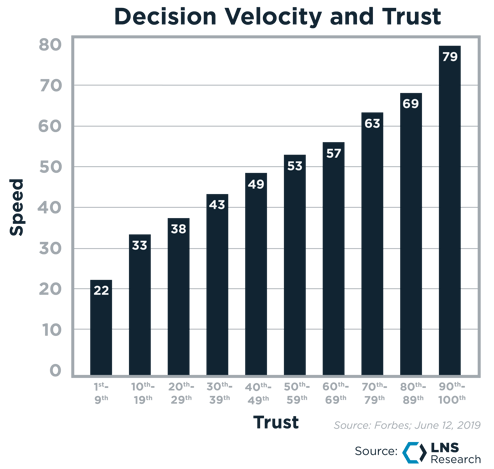
Figure 1: High trust enables high velocity
If your plant managers don’t trust quality insights, they hesitate. If engineering questions whether quality analytics reflect real customer feedback, they delay redesign. If executives believe quality is a cost center, they don’t invest. This uncertainty creates friction and decision drag.
Our recent research on the State of IX Tech, earlier this summer, shows a vast gulf between leaders and followers in trusting analytics and a wide range of autonomous tech. In this recent survey, leaders reported THREE times more trust and value from acting on analytics and autonomous technology than their peers.
Bottom Line: Trust Builds Decision Velocity and Competitive Advantage.
Slow Means Stuck. And Stuck Means Losing.
Slow quality decisions don’t just frustrate — they quietly erode trust across the enterprise.
-
-
-
Sales blames quality for losing deals.
-
Product teams bypass quality because it “slows us down.”
-
Leadership sees quality as overhead, not impact.
This creates a vicious loop: lack of trust → slow decisions → delayed outcomes → more distrust. Meanwhile, customer loyalty erodes. Clinging to traditional approaches to data curation and slow consensus building towards a decision results not in better decisions well considered, but actually lower accuracy and significantly lower speed to get to the right decision (Figure 2). This behavior is placing the quality function further and further behind the decision velocity curve compared to their value chain partners.

Figure 2: Advanced models produce better, faster decisions
Build a Fast, Trusted, Value-Creating Culture of Quality
A real culture of quality is built on three pillars:
-
-
-
Speed – enabled by trusted insights and autonomous action at the edge.
-
Alignment – across design, operations, supply chain, and customer.
-
Ownership – where quality isn’t something one function enforces, but every function delivers.
 This is what Embedded Quality brings: a transformation that connects Quality 4.0 technologies, sitting on a Quality Data Architecture, into a cohesive, trustworthy system that supports rapid, cross-functional decisions. Analysis of the impact of technology on quality decision velocity reveals a compelling argument for the quality function's desperate need to abandon traditional methods and adopt advanced technology.
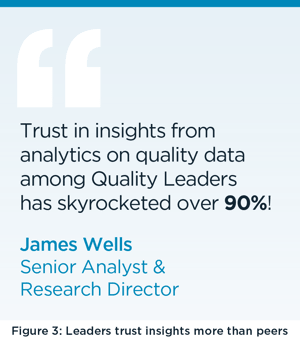
When trust is built, speed follows. Speed leads to a competitive advantage that no amount of compliance can match. In our research on Embedded Quality, we found that Leaders trust and act upon advanced analytics recommendations 90% more than followers, a radical departure from past performance (Figure 3).
Operationalize Trust. Accelerate Decisions. Earn Competitive Advantage.
 To break out of the compliance trap and shift from “slow and siloed” to “fast and integrated,” there are a few critical moves that quality leaders make. Our research on Embedded Quality shows that improving predictive quality is THE top goal for leaders. Predicting quality outcomes is not actionable until trust is built in the data quality and the indications of Advanced AI-enabled Analytics. Build closed-loop processes to ensure supplier input, design decisions, and frontline actions are contextualized, aligned, and data-driven. Our research shows that quality leaders are over 1.5 times more likely to do this than their peers.
Challenge Traditional Data Curation and Analysis Methods at Every Turn
Breaking old habits is a long game of repetition. Challenge traditional methods at every opportunity to establish the expectation to trust and act upon indicators derived from advanced models. Share trusted insights so Line Leaders, Operators, and Quality Engineers can act immediately and confidently in the best interest of the Delivered Quality mission.
Three Strategic Recommendations for Chief Quality Officers
1. Stop Treating Compliance as Strategy
-
-
-
Compliance is table stakes. To influence business results, quality strategy must be built around Delivered Quality outcomes, not audit performance. Reframe your internal metrics and storytelling accordingly.
2. Make Trust in Quality Data a Top Priority
-
-
-
Decision speed reflects data trust. Audit your organization for friction points where decisions stall due to skepticism of quality insights. Then fix the root: data context, consistency, and communication.
3. Build a Quality Data Architecture that Supports Fast, Frontline Decisions
-
-
-
Speed matters most where it’s needed most, on the plant floor and in the supply chain. Invest in advanced AI models and sophisticated analytics at the edge, connected through a unified Quality Data Architecture that enables trusted, high-velocity action across your value chain.
Conclusion: Compliance is not keeping you out of trouble. Trust Gets You Velocity.
A Culture of Compliance is about avoiding failure; data shows it is a losing proposition. A Culture of Quality is about accelerating success.
Manufacturers that confuse the two are setting themselves up for decision paralysis, eroded trust, and lost market share. But those who embrace Embedded Quality — with its focus on Delivered Quality, data-driven speed, and cross-functional alignment — position themselves not just to compete, but to win.