Asset Performance Management (APM)
Applying Maturity Models to Asset Performance Management
Learn about Asset Performance Management maturity models, and how to get your organization on the right path.

Assets are the cornerstone of industrial operations, and I don't mean the ones you'll find on the left side of a balance sheet; I mean the physical machines that run tirelessly in our factories and convert raw materials into finished goods. Throughout the several technology revolutions, these assets that are so critical to running manufacturing have changed, and as a result, so has the software and technology landscape that supports them.
Over the years, many categories of asset management software have emerged, ranging from Computerized Maintenance Management Systems (CMMS) to Enterprise Asset Management (EAM) to Asset Performance Management (APM), each addressing gaps left by the generation before it, and inadvertently creating a few of its own along with significant overlap. Fast forward to today, and we have on one side the original EAM vendors, most of whom have bought their way into the CMMS and APM space. On the other hand, we have the emergence of asset intelligence vendors who have leveraged state-of-the-art wireless sensors and machine learning to provide unprecedented levels of predictive and prescriptive maintenance and are expanding to CMMS and APM territory.
While these are market shifts on the technology provider’s side, the situation on the end-user side paints a different picture. Today's maintenance management and execution is a complex choreography spanning across several systems. There’s one that tracks sensor information and provides some intelligence, another on-premises system that analyzes similar data in a different way, one that the technicians actually use in day-to-day maintenance rounds, and one that carries long-term information. In many cases, these systems don't interact natively, and integration requires significant effort.
Which brings me to the question I posed in the title: how many pieces of software do we really need? In this blog post, we will take a modest attempt to answer that by looking at the current landscape, the trends, and the ideal end state to operate, maintain, and manage shop-floor assets as efficiently as possible.
Current State of the Industrial Asset Maintenance & Management Software Stack
Today’s maintenance is served by four distinct sets of software types (with an increasing number of overlaps, but we’ll get to that in a bit). In the order they emerged, they are: Computerized Maintenance Management Systems (CMMS), Enterprise Asset Management (EAM), Asset Performance Management (APM), and Asset Intelligence. Let’s take a quick look at each.
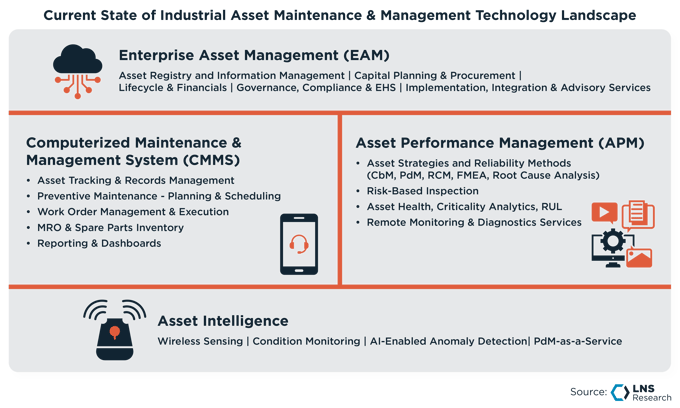
1. Computerized Maintenance Management Systems (CMMS):
The ‘C’ in CMMS is enough to tell its whole story. Back in the 90’s, it started as a way to computerize maintenance information off paper and into databases and software systems. The second wave of CMMS happened when cloud-native CMMS tools like Maintenance Assistant (Now Fiix, part of Rockwell) addressed existing challenges, which led to other cloud-native CMMS to emerge. Today, CMMS is a thriving market with a focus on empowering maintenance technicians with mobile-first, AI-native tools, and at the same time adding EAM features. I like to think the C today stands for Collaborative, as they play a critical role in empowering the connected workforce and collaborate between not just maintenance and reliability but across the value chain.
Vendors in the CMMS II space include (but are not limited to): Eptura, Fluke Reliability, FMX, Fracttal, IFS (Ultimo), Limble, Llumin, MaintainX, MVP One, Rockwell Fiix, and Upkeep.
2. Enterprise Asset Management (EAM):
As mentioned above, EAM systems were the answer to the first generation of CMMS that were too narrow in scope. As maintenance procedures and software matured, companies needed to manage assets with more information and a longer time period, and not just look at day-to-day work orders. In doing this, EAM over-indexed on the enterprise – the financials, compliance, governance - and bloated up as a bulky software that took too long to implement and a user interface that was far from what the maintenance technicians needed. Most of the EAM vendors today are prevalent in the large asset-intensive industries, while a smaller set of companies, like Ultimo, are bridging the gap by moving down the stack into CMMS territory.
Vendors prevalent today: Hexagon HxGN EAM (Infor), Hitachi Ellipse (bought from ABB), IBM Maximo, IFS Cloud EAM, Oracle Fusion Cloud Maintenance, SAP S4 EAM.
3. Asset Performance Management (APM):
While CMMS and EAM focused on systems of record and execution for maintenance, APM addressed the intelligence gap. It provided first-principles and rules-based ways to analyze which assets are about to fail and what to do about them — the reliability side. Its core capabilities span asset strategies, failure libraries, and analytics, with data drawn largely from historical sources like plant historians, IoT sensors, licensed failure libraries, etc.
Vendors are ABB, AVEVA, Bentley Systems, Emerson, GE Vernova, Hexagon, Hitachi, Honeywell, IBM Maximo APM, IFS APM, and SAP APM.
4. Asset Intelligence:
Asset Intelligence is the newest layer, and like APM, it was born on the data and reliability side. As computing became more affordable, this wave of companies took a hardware-plus-software-plus-services approach — wireless sensors that capture not just vibration but temperature and ultrasound, generating clean data and delivering predictive and prescriptive recommendations with far lower false-positive rates than earlier methods. It's a viable and growing space, and more and more of these companies are moving up the stack.
Vendors: AssetWatch, Augury, I-Care, Fluke Reliability (Azima DLI), Infinite Uptime, KCF Technologies, Nanoprecise, Tractian, Waites.
What Does an Ideal Asset Maintenance & Management Tech Stack Look Like?
In spite of all these software categories and technological revolutions, maintenance still runs in a suboptimal way at many companies: reacting to unplanned events, spending too much time firefighting, and navigating multiple systems and dashboards for required data and information. Every technology wave creates a new system that solves a part of the problem, but at the same time adds yet another dashboard to manage and review. For example, the more recent Asset Intelligence category is more sophisticated but highly cost-prohibitive, so most users just stick to critical assets, while other analytics tools are used for non-critical assets.
So what's the ideal solution? The engineer in me considers this as a fairly straightforward optimization problem, solving for the most number of capabilities from the fewest number of categories. Just as with many optimization problems, the answer lies in the middle: it can’t be one system for every use case, but you also can't have a single platform for everything (as we found out from the Industrial IoT platform days). But where do we draw the line? By looking at the personas, data types, decisions impacted, and timeframes, a line can be drawn between the maintenance and the reliability sides.
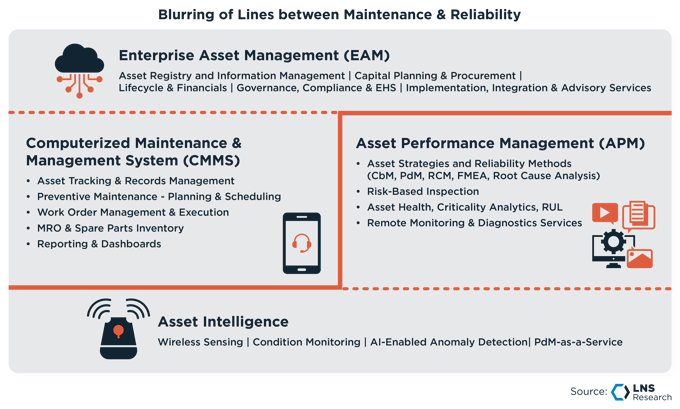
On the maintenance side, CMMS has won the race by focusing on providing maximum value to its persona and paying down its tech debt, and has also added enterprise features including asset tracking, records management, and more. On the other hand, EAM doubled down on enterprise-level features, the kind that matter most to the largest companies with the most numerous and expensive assets, becoming a monument enterprise system in its own right, much like ERP. Along the way, though, it moved further from the usability that the maintenance shop floor needs.
This divergence further reinforces the hypothesis that the current CMMS is where maintenance technology is heading. Just as MRP grew into MRP II decades ago by widening its scope, it's not far-fetched to imagine the computerized CMMS becoming a collaborative CMMS II: the piece that owns maintenance execution and the asset record, while the financials and depreciation move to the ERP, where they arguably belong. It is important to note that modern APIs and Agentic workflows make this separation possible in a way that simply didn't exist back when EAM and CMMS had to be two separate systems in the first place.
On the other side sits reliability and intelligence. I believe that for industrial AI to succeed at driving decisions, and eventually at enabling autonomous operations, it needs both probabilistic and deterministic models. That means Asset Intelligence and APM are becoming one: wireless sensing combined with the breadth of process information, historical context, and failure-mode libraries that APM brings. Predictive accuracy is already high, but reaching more precise recommendations and true prognostic capability requires these two to come together as one: Asset Intelligence and Performance Management.
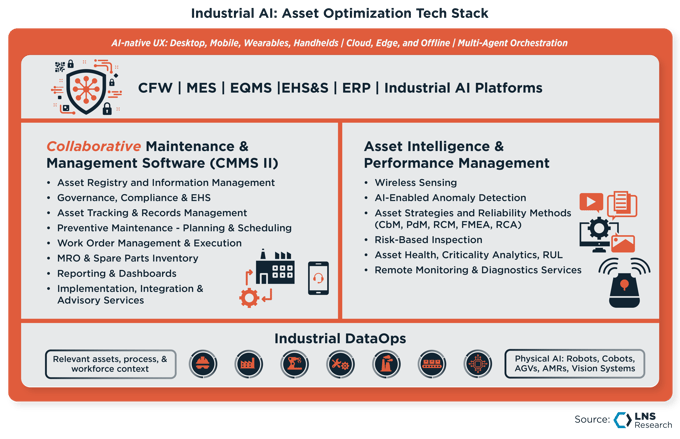
Finally, two things have to be true for this to work. First, both systems need to draw from a common data infrastructure, enabled by DataOps platforms, unified namespaces, and industry APIs like I3X, so we don't end up creating data silos, or worse, AI silos. Second, their output needs to be accessible to other platforms, including Connected Frontline Workforce (CFW) tools, other execution and intelligence systems, and systems of record.
Summary & Recommendations
There is no question that asset maintenance is a crucial part of manufacturing. Especially in asset-intensive process industries, it can account for as much as 20% of operating costs, so getting it right is not a back-office concern; it shows up directly in the P&L. Yet the current landscape asks manufacturers to run too many systems to do it. There is often one tool for critical assets and another for the rest, some on-premises and some cloud, with pockets of modern technology scattered among legacy systems that don't talk to each other. The recent wave of AI gives us a unique opportunity to consolidate and optimize all of it.
In the ideal future state, that sprawl collapses into two interoperating systems. One serves the reliability team: Asset Intelligence and Performance Management, which catches failures early and says what to do about them. The other serves the maintenance team: a mobile-first CMMS II that runs the work and holds the record. Both sit on a shared data foundation, so a prediction on the reliability side becomes a work order on the maintenance side without significant custom integration. Here are some recommendations for maintenance leaders:

Learn about Asset Performance Management maturity models, and how to get your organization on the right path.
Discover the essential pillars of APM that solution providers are trying to solve for, including a sneak peek into LNS Research’s upcoming APM SSM.
LNS Research details 20 of the most commonly used acronyms in the asset performance management (APM) space.