A couple of weeks ago, I attended iBase-t’s Excelerate 2026 user conference. With record attendance of 350+ participants, including a 40% increase in customer attendance, the event reflected a company at an inflection point. The three-day program delivered a clear thesis: in aerospace and defense, programs don’t fail in design reviews. They win or lose in execution. What made this year’s event different from a typical vendor conference was the degree to which customers, not iBase-t, carried that message.
Execution Moves to the Center
CEO Naveen Poonian opened with a framing that set the tone for the entire conference. Roughly 80% of costs in A&D live in operations, on the shop floor, in production, in sustainment. Single-digit percentages live in design and administration. Yet the industry has historically invested disproportionately in PLM and ERP while treating manufacturing execution as a downstream concern. Poonian’s argument: execution is moving to the center of the digital enterprise, and iBase-t’s role is to be the domain specialist that makes that possible.
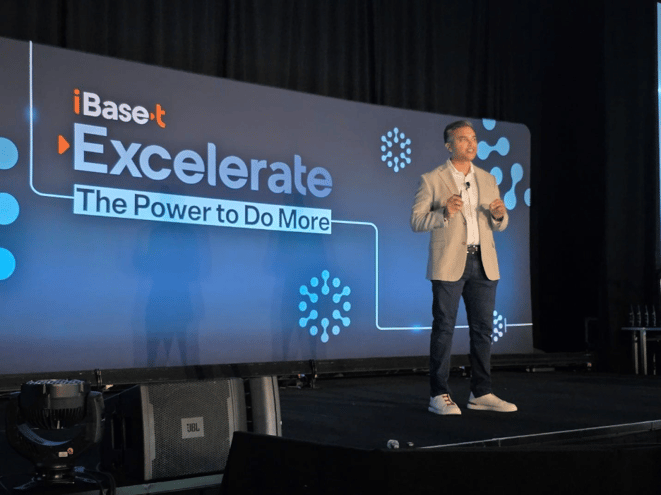
Figure 1 - iBase-t CEO Naveen Poonian
The positioning was explicit. iBase-t is not a PLM company extending into manufacturing execution, and not an ERP company reaching down to the shop floor. It is a purpose-built MES for aerospace and defense, and Poonian framed that focus as a strategic advantage rather than a limitation. The biggest AI problem in manufacturing, he argued, is not the algorithm. It is the data. And the data that matters most, the operational data from production and sustainment, is exactly what Solumina captures.
He also pointed to the growing influence of iBase-t’s customer community. The Solumina User Group, formed just one year ago at Excelerate 2025, now has over 100 active members who helped shape the i130 release and are already influencing i140 and i150. Model-based manufacturing was positioned as the next frontier: connecting model-based engineering directly to shop floor execution, moving from documentation-driven to model-driven digital manufacturing.
Customer Stories That Proved the Point
The most compelling sessions at Excelerate came from the customers themselves, and they painted a consistent picture of operational transformation grounded in pragmatic execution.
GE Aerospace presented what may be the most telling deployment story in the MES market right now. Their component repair network, the most complex part of the MRO operation, was running on paper-based processes against legacy systems dating to the 1980s. Previous attempts to deploy customized SAP and a homegrown MES had both failed. GE signed a PO with iBase-t in April 2024 and had their first production cell live 354 days later. The approach was deliberately incremental: cell-by-cell rollout in South Texas, with 192 router revisions in the first 90 days as the team learned what it meant to move from paper to digital. Their next site, Singapore, with 22 cells, has its first cell going live in 53 days from the presentation date. The integration with legacy ERP systems, originally estimated at 18 months, was completed in seven months using straightforward Python scripts on AWS Lambda. GE’s message was clear: let the MES do what MES does, let the ERP handle invoicing and materials, and stop trying to make one system do everything.
Leonardo DRS brought data. After conducting formal time studies comparing the new iSeries Web UI against their legacy GE client, they measured a 64% performance improvement. More interesting was the backstory: an initial measurement of 30% turned out to be artificially limited by a server architecture flaw. Once fixed, the actual gain exceeded iBase-t’s own benchmarks of 60-68%. DRS also shared a critical lesson about sequencing. Before tackling the system deployment, they removed over 200 procedures from their Quality Management System, recognizing that system complexity made integration impossible without first reducing business process variation.
Honeywell demonstrated that upgrading a heavily customized i70 environment to i110 could be done without disrupting production. By running the new system in parallel on a separate Kubernetes cluster and aligning cutover with a planned plant shutdown, the team reduced risk to the point where the hyper care team was “looking at each other just waiting for something to happen” by day three. Their advice to the audience was straightforward: “Don’t be afraid to upgrade. Plan, test, test again. If you think you’ve tested enough, you’re not thinking hard enough.”
From AI-Enabled to AI-Native Manufacturing
CTO Sung Kim drew a line that the rest of the industry should pay attention to. AI-enabled manufacturing, he argued, means adding a chatbot on top of an existing system and building more dashboards. AI-native manufacturing means embedding intelligence directly into operations, where decisions are augmented in real time by a system that understands the manufacturing context.
The distinction matters because A&D operates under constraints that consumer technology does not. Export controls, security classifications, audit requirements, and FAA certification mean that AI cannot sit above the trust model. It must inherit it. Every AI interaction in Solumina follows the same APIs, the same authentication, the same role-based access controls, and produces the same audit trail as any human action. This is not a governance afterthought. It is the architecture.
The practical products include Solumina AI, which went GA in January 2026 and encompasses several capabilities: Scan AI, which converts paperwork instructions to Solumina process plans (currently in customer testing, targeting an 80% reduction in time to get information into Solumina), Digital SME for institutional knowledge queries, and Pulse AI for operational dashboards. The roadmap points toward MRO work scoping with AI assistance, predictive KPIs, and agent-assisted actions, all running within the existing security boundary, including air-gapped deployments for ITAR customers.
Kim used a cloud analogy worth repeating: organizations that treated cloud as infrastructure, simply moving servers, saw different outcomes than those that treated it as an operating model. The same inflection is happening with AI, but at a pace measured in months, not years.
A Company That Grew Up Five Years in One
Perhaps the most unusual session at Excelerate was CRO and Head of Customer Success, Sebastian Grady’s public scorecard on iBase-t’s own shortcomings. For the second consecutive year, Grady stood in front of the entire customer base and graded the company’s performance against ten improvement areas, giving himself a “B, B-minus” on SAP integration and openly acknowledging where gaps remain. A customer in the audience told him the night before: “It feels to me that you guys have matured as a company five years in the last year.”
The Solumina User Group, now 94 members from 21 companies, has become a genuine product development channel. The group identified 80 topics across seven functional areas, with 53 feeding directly into the i140 feature voting. A practical example: the quality subcommittee reduced a rework process from 80 button clicks to five by providing real-time feedback during i130 development. As one customer put it, when customizations become part of the core product, “that’s millions of dollars saved” in reduced technical debt.
The i130 release, shipping March 31, delivers process planning in the Web UI (the number one customer request from last year), 70-80% performance improvements over the Win client, and the beginning of MBE capabilities with in-process 3D models connected to operations. The Win client retirement is planned for i140, which would bring the iSeries to full web parity.
Where the Work Remains
To their credit, iBase-t's leadership did not limit Excelerate to success stories. Grady's public scorecard and the candid Q&A sessions made it clear that the team sees the gaps and is actively working to close them. That transparency is worth acknowledging, and so is the distance still to travel.
SAP integration is the most visible open item. Grady graded himself "B, B-minus" and was direct about the gap: customers running SAP alongside Solumina still lack a clear, cohesive integration recommendation. The building blocks exist. eQ Technologic has built connectors for SAP ECC6 and S/4 HANA, and iBase-t has its own 14-touchpoint connector. The work now is bringing these options into a coherent recommendation. Grady committed to "a much more specific recommendation in 3 months," which will be worth watching.
The AI-native manufacturing vision is compelling, and the team is building toward it deliberately. Solumina AI went GA in January 2026, and Scan AI is in active customer testing. The rest of the AI roadmap, including MRO work scoping, agent-assisted actions, and predictive KPIs, is forward-looking. iBase-t is taking a measured approach to AI rather than rushing features to market, which is appropriate for A&D. Manufacturers should evaluate what is available today and plan for what is coming, rather than treating the roadmap as a current capability.
Model-based enterprise, a central theme at Excelerate, is still in early innings for the industry as a whole. Collins Aerospace presented its MBE progression across 160 global sites, with 34 currently on Solumina and over 20 PLMs in its ecosystem. Their candid self-assessment: "level two at best" for MBE maturity, given the complexity involved. The i130 release brings the first in-process 3D model capabilities, and the i140 roadmap shows continued investment, but the distance between connecting a model to an operation and running a fully model-driven production environment across an enterprise is considerable. This is an industry challenge, not an iBase-t shortcoming.
Service capacity is a constraint that the leadership is addressing on multiple fronts. Global services headcount is up 25%, but Grady acknowledged that demand is still roughly double supply. iBase-t is actively building out its partner ecosystem, and the Excelerate sponsor list reflected that priority: Razorleaf (who presented alongside Honeywell on their upgrade), Tech Mahindra (GE Aerospace's infrastructure partner), DXC, Capgemini, and Accenture all had a visible presence. eQ Technologic presented multiple sessions on PLM-MES-ERP integration and received strong feedback from end users, particularly around their work with Leidos on FedRAMP-compliant deployments. The partner's intent is clear. The challenge is talent. iBase-t Solumina expertise is still concentrated in the existing customer base, while general MES implementation experience is widely available but does not easily transfer to A&D-grade regulated environments. The move to a modern Web UI helps lower the learning curve, but building a deep bench of Solumina-qualified SI consultants will take time.
Finally, the iSeries migration itself is a multi-year effort. Approximately 150,000 users across the installed base still need to upgrade from the G-series. iBase-t has made this one of its five big priorities for 2026, and the customer stories at Excelerate showed it can be done well. The question is pace: each deployment required dedicated teams, months of planning, and deliberate cell-by-cell rollout. Scaling this across dozens of A&D sites globally is a different challenge than proving it works at one.
What Manufacturers Should Take Away
Execution-first is not a platitude when customers prove it. GE Aerospace, Leonardo DRS, Honeywell, and Leidos each demonstrated that MES deployments in regulated environments can succeed when they start small, measure rigorously, and resist the temptation to customize. The consistent pattern was cell-by-cell or site-by-site rollout with deliberate learning phases.
AI in regulated manufacturing requires a different architecture than AI in the enterprise. The “move fast and break things” approach does not work when an FAA auditor needs to trace every decision. Manufacturers evaluating AI for operations should ask vendors how AI inherits their existing trust model, not how it replaces it.
Invest in the user community, not just the software. The Solumina User Group demonstrated what happens when customers have a structured channel to influence product direction. For manufacturers on any MES platform, forming or joining a user community is one of the highest-return activities available. The cost is time; the return is a product that actually reflects how you work.