Declining industrial productivity has become one of the most critical challenges facing manufacturers today. LNS Research’s latest Industrial Productivity Index™ (IPI) data shows that industrial productivity has fallen by 49% since 2004. While there was a short-lived 22.3% rebound between 2020 and 2022, productivity has since declined another 12%, reinforcing the long-term negative trend.
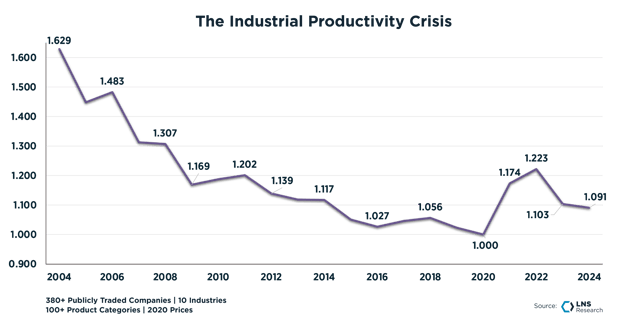
This sustained decline is not cyclical; it reflects a systemic erosion of competitive advantage that affects every corner of the industrial sector. However, amid the downturn, a small group of companies, the Productivity Pathfinders, has not only avoided decline but has consistently improved productivity and financial performance, widening the gap between themselves and the rest of the industry .
LNS Research defines productivity growth as a value-adjusted ratio of outputs to inputs, measured across the entire value chain, not just labor or materials. By grounding the IPI in established economic frameworks such as Total Factor Productivity and Endogenous Growth Theory, the model provides a rigorous, apples-to-apples view of true operational efficiency. My previous blog post on this topic provides a more detailed description of the Industrial Productivity Index and provides some clarity on the math behind it.
In this blog post, we examine three distinct pathways to productivity improvement used by the Top 3 World’s Most Productive Companies: First Solar, Pilgrim’s Pride, and Linde. Each represents a viable strategic approach, shaped by market conditions, competitive dynamics, and organizational capabilities. Understanding these pathways is essential for industrial leaders looking to define and execute their own productivity journey.
Lessons from the Top 3 Pathfinders 2025
The first pathway represents what many consider the ideal productivity scenario: increasing output delivered while reducing input consumption. This approach requires organizations to fundamentally rethink how they create value, often through technology adoption, process innovation, and operational excellence initiatives.
First Solar clearly exemplifies this pathway: between 2019 and 2024, the company achieved a remarkable 43% increase in output while simultaneously reducing inputs by 27%. This combination of output expansion and input reduction represents the most powerful form of productivity improvement across both dimensions of the productivity equation.
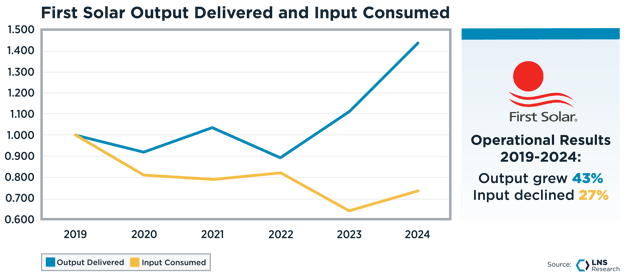
First Solar's achievement did not occur by accident. The Tempe, AZ-based company made deliberate investments in advanced manufacturing capabilities, including next-generation thin-film photovoltaic technology and highly automated production processes. These investments enabled the company to scale production significantly while decreasing the resources required per unit of output, and also insulating it from the Chinese-dominated solar panel supply chain. The result is a productivity profile that positions First Solar among the elite Productivity Pathfinders -the top 30 performers in our analysis - twice in a row!
This pathway is most commonly observed in what LNS Research refers to as production-constrained environments, where the primary challenge is keeping production capacity aligned with strong or growing demand. This approach demands substantial upfront investment and organizational commitment to continuous improvement. However, the payoff is enviable, as showcased by First Solar: companies that successfully execute this approach often achieve sustainable competitive advantages that are difficult for competitors to replicate.
The second pathway acknowledges a practical reality: growth often requires additional resources. The key to productivity improvement in this scenario lies in ensuring that output growth significantly outpaces input growth. Organizations following this pathway expand their operations while maintaining disciplined control over resource consumption.
Pilgrim's Pride demonstrates this approach effectively. Between 2019 and 2024, the company increased output by 36% while inputs remained constant, more or less. This differential - output growing more than three times faster than inputs - translates into substantial productivity gains despite the absolute increase in resource consumption.
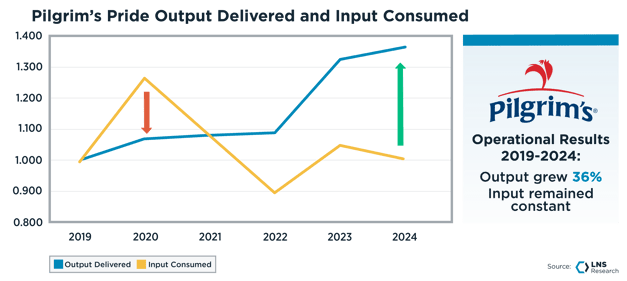
For Pilgrim's Pride, this achievement reflects strategic investments in operational efficiency throughout its value chain. The company expanded production capacity and market reach while implementing initiatives to optimize labor productivity, reduce material waste, and improve energy efficiency. The result is a business that has grown significantly while becoming meaningfully more productive per unit of input.
This pathway is also relevant for companies operating in production-constrained markets, where market pull justifies capacity expansion and standing still is not a viable option. In these conditions, productivity improvement does not come from eliminating inputs altogether, but from ensuring that output growth consistently outpaces input growth. The imperative is not to avoid growth-related input increases, but rather to ensure that every incremental unit of input generates proportionally greater output. Companies that master this balance can scale their operations while simultaneously improving their productivity.
The third pathway may seem counterintuitive, yet it represents a strategically valid approach to productivity improvement: reducing both output and inputs, with inputs declining at a faster rate. This pathway is often associated with portfolio optimization, market rationalization, or strategic repositioning.
Linde illustrates this approach. Between 2019 and 2024, the company's output declined by 6% while inputs declined by 22%. Despite the absolute reduction in output, Linde's productivity improved because the company eliminated a disproportionately larger share of inputs. In effect, Linde became a leaner, more efficient organization.
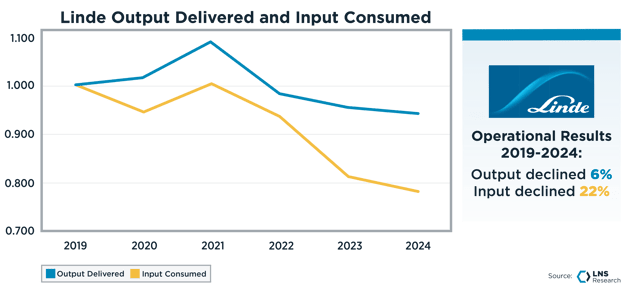
Linde's trajectory reflects deliberate strategic choices following its merger with Praxair. The company rationalized overlapping operations, divested non-core assets, and streamlined its portfolio to focus on higher-value segments. The result is an organization that, while smaller in absolute output terms, generates significantly more value per unit of input consumed.
This pathway represents a fundamental inversion of the demand-constrained cases discussed earlier. In this demand-constrained environment, the challenge is no longer how to meet demand, but how to intentionally reduce it to restore economic efficiency. This situation is common in mature, saturated, or commodity-like markets, as well as after large mergers, where excess capacity, overlapping assets, or low-value demand erode productivity. Success in this pathway requires the discipline to shed inputs faster than output declines, often through portfolio rationalization, capacity reduction, and strategic focus. Companies that execute this approach emerge more focused, more efficient, and better positioned to compete and win in highly competitive markets with razor-thin margins.
LNS’s research on Industrial Productivity Growth demonstrates that there is no single formula for productivity improvement. The World’s Most Productive Companies, such as First Solar, Pilgrim’s Pride, and Linde, achieved outsized gains through fundamentally different pathways, shaped by whether they operated in demand-constrained or production-constrained environments. What unites them is a clear understanding of the productivity equation, the relationship between output and input, and deliberate strategic imperatives to improve that ratio and impact topline and bottom-line financial performance along the way.
The data speaks clearly to the value of this focus: analysis of this database of 700 of the largest industrial companies across the globe reveals that a 1% increase in industrial productivity corresponds to a 1.3% increase in operating margin. Companies in our Productivity Pathfinders cohort demonstrate 28.7% higher operating margins, 44.7% higher net income ratios, and 52.5% higher return on invested capital compared to their peers.
For industrial leaders, the imperative is to assess which pathway aligns with your strategic context and operational capabilities. Whether pursuing aggressive growth, disciplined expansion, or strategic rationalization, the common thread is an unwavering focus on the productivity equation. In an environment where macro-level productivity continues to decline, the companies that master this equation will define the competitive landscape of industrial markets for years to come. I strongly urge manufacturing leaders to:
-
-
-
Benchmark Industrial Productivity: As my colleague Niels Andersen often reminds us, echoing Lord Kelvin, “You cannot improve what you cannot measure.” The challenge in industrial productivity is not the choice of metric itself, but choosing metrics before clearly defining the business objective. Too often, organizations default to measures like OEE or yield without first asking what outcomes truly matter. While efficiently converting raw materials into finished goods is important, optimizing the wrong metrics can lead teams to improve local performance without improving productivity, and subsequently, the organization’s competitive advantage at all.
-
Make Things Different: One of the defining characteristics of the World’s Most Productive Companies (WMPC) and the Productivity Pathfinders is their willingness to rethink how they fundamentally operate. This goes beyond digitizing existing processes; it involves reimagining product mixes, redesigning processes, and reshaping operating models to create lasting competitive advantage. Case studies of WMPCs show that this ability to “make things different” is a critical enabler of sustained productivity growth.
-
Prioritize A Collaborative Supply Chain Over a Competitive Supply Chain: Another key differentiator among WMPCs and Productivity Pathfinders is how they engage suppliers and customers. Many manufacturers still operate within adversarial or purely transactional supply chain relationships, sharing limited data and optimizing only their own operations. In contrast, the most productive companies treat suppliers and customers as true partners, openly sharing not just data but insights, aligning on goals, and working together to improve the performance of the entire value chain.