Depending on how you count, I have been in the MES business for 40+ years (which is why I am a “Research Fellow” – because I am so old!) Yet, I am excited to report on some preliminary findings from recent MES work.
LNS Research kicked off its Solution Selection Matrix (SSM) process around MES earlier this year. Our process includes surveying the vendors (think something equivalent to an RFP), participating in vendor briefings specifically on the topics of the survey, reference calls to seek external validation of vendor claims, and iterations of drafts of the SSM document to ensure accuracy and completeness.
We see more than one MES market, so we have organized the SSM by “peer group,” trying to compare vendors against those companies they actually compete with, rather than MES vendors that, because of industry or process family, they never see. We are in the throes of the “Large Discrete MES” SSM and already seeing some interesting trends and differentiation. Here, I want to cover 9 trends/questions that are interrelated.
1. The King is Dead, Long Live the King! Discrete-Focused MES Suppliers are all Growing
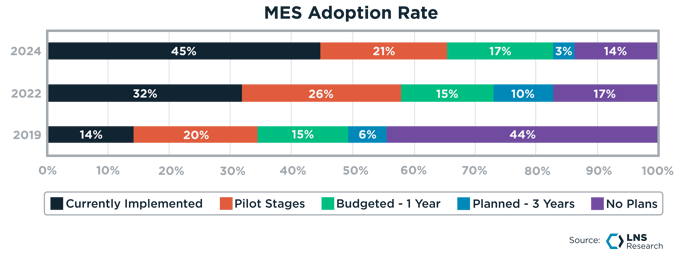
All the vendors serving discrete manufacturers report growing revenues and ARR. We have not yet created a weighted average, but a 30%+ CAGR over the last three years was the norm. This, despite all the talk about MES as a dying category, cloud being the future, does not align well with most vendors’ offerings, etc. In fact, this revenue growth aligns with our survey findings, which show increasing MES adoption. All vendors had aggressive growth plans looking into the future.
The growth is reflected in generally aggressive development plans. While the space has been around for more than 50 years, and these vendors have all been in the business for 15+ years (many much longer), their product roadmaps are generally very robust with significant investment (this may not be true across all the “peer groups” — we will have to watch.)
2. On-Premise is Here to Stay in MES
Cloud deployments may be the only “modern” option for many categories of software, but MES continues to be dominated by on-prem deployments. All the vendors now have cloud offerings. All can offer fully cloud alternatives and/or hybrid deployment models. Yet, most reported that most of their deployments include a large on-prem component, as safety, equipment automation, response times, and 7/24/365 requirements drove manufacturers to require on-prem implementations. In fact, many of the start-ups in this space that started with a cloud-only option are actively launching on-premise versions.
“Air gapped” deployments are often required in A&D, nuclear, and other security-sensitive environments.
We'll cover each vendor's cloud offerings in more detail below.
3. Classical MES or Transformation Oriented
MES has traditionally been focused on the plant, the plant manager, and improving manufacturing productivity. All the vendors still embrace that classic model in deploying MES. LNS Research believes this is still fundamental to the vision of MES.
Increasingly, some vendors are seeing MES as core to Industrial Transformation and have broadened their messaging and offering to support Industrial Transformation. LNS Research has published on how IX is driving MES demand, and we see some vendors targeting those demands as well. Whether it is Model-Based, PLM-driven digital threads, autonomous demands, or providing the “context” for Industrial AI, MES has a big role to play in the Transformation stack. Some vendors are making it critical to their mission.
4. Top Down or Bottom Up
One reason for this distinction is a fundamental view of the role of MES.
A previous coworker here at LNS Research, Andrew Hughes, was famous (at least in my mind) for saying that MES is “bottom of the enterprise layer, not the top of the automation layer.” MES is in the middle so that it can play both roles. But some vendors are very focused on “automation up” or “business systems down.” This viewpoint is influencing their product roadmaps and marketing strategies.
LNS Research also sees customers viewing MES in both ways. CIOs and Transformation executives look at MES as the execution layer of their enterprise applications. For example, Model-based Enterprise is, by definition, a top-down view. Enterprise rollouts of MES are typically driven by a top-down perspective. In this view, MES is an IT application.
Operations typically look at MES as linking islands of automation and tracking the data needed to drive the next stage of process improvement. In this view, MES is an OT application.
Vendors are often optimizing their solution, marketing, and sales messages around one of these approaches (even if their product could play both roles).
5. Manual vs. Automated
This distinction is partially driven by the level of automation targeted by the vendor. In some industries, the core of operations is typically manual operation (A&D, Industrial Equipment, for example). Vendors serving those industries optimize their systems for these environments, even if they have an equipment integration capability. Other industries are typically highly automated (e.g., electronics manufacturing). Vendors serving those industries optimize their systems for these environments, even if they have manual data collection capabilities.
6. Rest of the Fleet vs. Aircraft Carriers
All the vendors are rolling out new offerings, including new-ish cloud offerings. Some of the vendors see these offerings as supplementing/supplanting their traditional offerings over time. Some of the vendors are very specifically positioning the offering for the “rest of the fleet”.
LNS Research noted the growing interest within the largest manufacturers for solutions targeting their smaller offerings rather than the largest plants (the aircraft carriers), which have already implemented MES. We field questions all the time about whether vendor X could be installed in all 150+ remaining plants in their manufacturing network. They often are looking for easier-to-implement, smaller applications. Cloud offerings can be advantageous for the “rest of the fleet” as smaller plants may not have the IT or OT resources to implement or support big applications.
In many ways, some large manufacturers are thinking about a two-tiered MES strategy, like the two-tiered ERP (SAP for the largest businesses, SMB focused ERP for the rest of the fleet).
We have heard MES vendors position their newest offering with a modern architecture toward their core business of large plants, or toward the rest of the fleet, assuming their core offering will deliver the growth needed for them into the future.
7. MOM or “MES Lite,” Anyone? What's in a name?
This is the core access of differentiation between vendor strategies.
Some vendors are looking for easy ways to get in quickly within a plant by making MES more digestible. These vendors are trying to make MES “composable” so that manufacturers can start with any number of point solutions on their way to full MES. (This does not even count the Manufacturing Application Platforms that are explicitly starting with piece parts. They will be covered in a later “MAP peer group” SSM.) Full MES is the goal, but some vendors are explicitly disaggregating their products to make them more digestible. We wrote about the puzzle of MES and the holy grail, and are seeing some vendors position their offerings as a series of apps that can be built into a comprehensive MES.
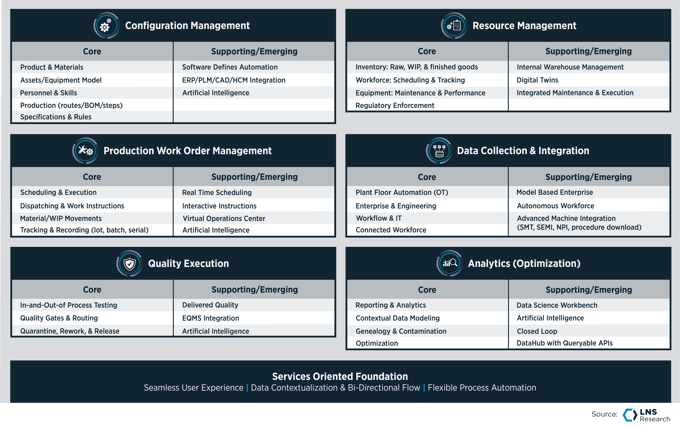
The other dimension is from MES to MOM. Some vendors are using the “Beyond MES” positioning. Others prefer the term MOM to portray a bigger solution set. As early as 2012, LNS Research wrote about the confusion in the name of this space: is it MES or MOM? LNS Research has gone back to using the name MES because that is what most manufacturers call it, but believe MOM is the best way to characterize the space.
LNS Research, therefore, sees the market today as characterized by 4 types of implementations
-
-
-
Manufacturing Apps (including very small ones) built by MAP providers
-
“MES Lite” as a manufacturing App delivered on an MES platform as a first step into comprehensive MES.
-
Full MES
-
Going beyond MES to MOM with plant scheduling, analytics, etc. (The LNS Research definition of MES absolutely embraces this wider scope.)
LNS Research views this as an important question manufacturers must ask themselves before moving to solution selection: What is the vision of their final stage of MES?
8. AI Everywhere but Still in Early Stages
All the vendors have rolled out or are rolling out AI applications. Not surprisingly, few of these applications are in widespread use yet, but some of the implementations are doing impressive things already with the technology. But the range of AI applications offered by this set of vendors is impressive: from fully “air gapped” offerings to seemingly robust industrial AI optimization capabilities. In fact, we are seeing vendors implementing two distinctly different yet complementary approaches to AI:
-
-
-
-
Embedded AI. MES vendors build AI into their products to make them easier to use, automate tasks that were previously manual, and answer questions based on the data and capabilities of the MES itself.
-
Orchestrating AI. MES vendors enable their software to participate in broader enterprise AI workflows. Using technologies such as MCP, A2A, and APIs, AI can access and coordinate information and actions across multiple applications, reducing the need for custom point-to-point integrations and enabling enterprise-wide reasoning, analytics, and process automation.
Given the rapidly evolving nature of AI more generally, manufacturers should probably not yet choose a discrete MES vendor based primarily on their AI offering, as it will likely radically evolve over time.
9. These Vendors Still Don't Get the Core Value of CFW
LNS Research has written extensively on Connected Frontline Worker applications and the Future of Industrial Work. “Frontline” is a great word to cover the execution/users that most discrete MES systems now cover: materials/warehousing, production, quality/lab, and equipment maintenance. Most MES companies have robust UI’s and/or UI development tools. Many discrete MES companies offer impressive “connected worker” capabilities with AR/VR offerings. But MES companies do not see the need for or demand for CFW applications.
We have detailed the difference here. 3 words characterize what the best CFW systems do for operators that are simply outside the scope of MES operator interfaces: “Win the Day.” MES systems, particularly those focused on the Model-Based Enterprise, fail to look at it from the perspective of how to help an operator “win” their day. Operators do several tasks, such as machine setup or plant maintenance, that are only tangentially related to the specific product running on their machine. They may be operating several machines, working on different products at the same time. Their MES “tasks” are only a portion of their workload.
All in all, I have been in this for a long time, and still I am impressed by the diversity, investment, and focus of the “large discrete MES” vendors.