With the emergence of Industrial DataOps, the OT side of the fence is finally getting the attention and solution it deserves, which IT has been getting for quite some time now. Over the past few years, multiple waves of technology and vendor activity have targeted this challenge. But I believe we have now reached a tipping point. Significant capital flows, new product launches, open-source momentum, and accelerating adoption tell us that Industrial DataOps is no longer an emerging concept.
Combining agile, lean, and DevOps principles, Industrial DataOps offers an efficient and effective way to manage, contextualize, and orchestrate industrial data without waiting for perfection. At LNS Research, we have formalized this through our Industrial DataOps framework. In this post, I will share some recent research on Industrial DataOps adoption, a few recent market developments, and what industrial leaders should be doing right now to keep up.
Current State of Industrial DataOps
The case for Industrial DataOps starts with the fact that most industrial data quality levels are not ready for analytics, let alone AI initiatives. Data quality has consistently been the number one challenge in advanced analytics and AI initiatives. Most industrial companies have data analysts and engineers spending 70-80% of their time cleaning and preparing data rather than analyzing it.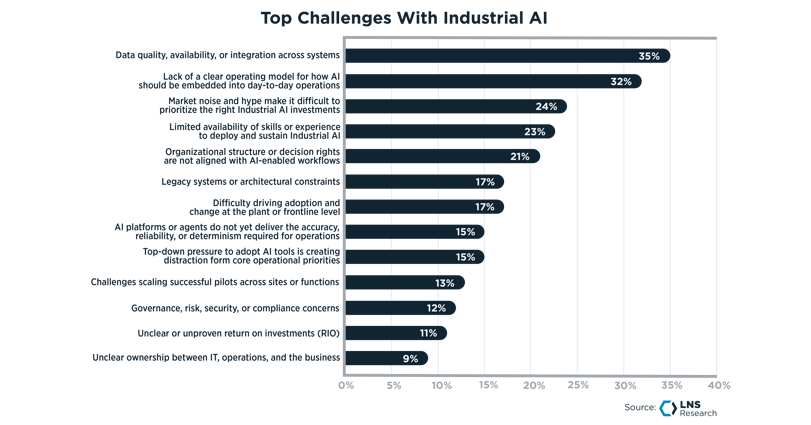
Recent LNS Research survey data shows that Industrial AI Leaders - the top 18% of respondents who are successfully scaling industrial AI and have measurable business results to show for it - are significantly ahead in adopting DataOps to solve the data quality bottleneck.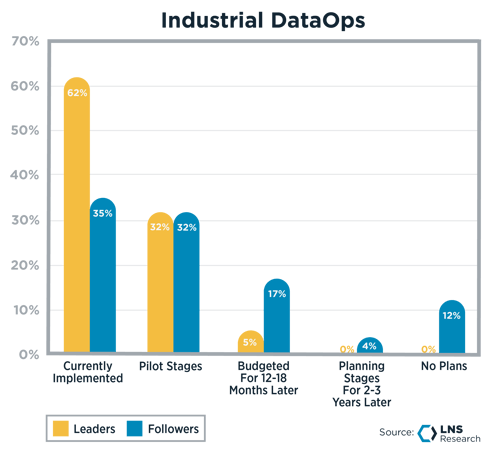
62% of these Industrial AI Leaders have actively implemented Industrial DataOps practices (data quality, conditioning & contextualization, governance, etc.) compared to just 35% of Followers. And the differences sharpen when we look at specific capabilities, such as interoperability, Unified Namespace, etc. However, the most telling finding sits at the bottom of the maturity curve. Among Leaders, virtually none report having "no plans" for DataOps-related governance. Among Followers, a meaningful percentage still has no plans at all. Once organizations reach a certain level of AI maturity, DataOps becomes inevitable rather than optional.
What’s Happening in the Industrial DataOps Vendor Landscape
Over the past few months, the Industrial DataOps vendor landscape has seen a remarkable stretch of activity. Major divestitures, new product launches, fresh funding rounds, and strategic investments from outside the traditional industrial technology ecosystem are all converging at once. It is important to note that these are not isolated events. Taken together, they signal that Industrial DataOps has crossed from early-adopter curiosity into a market attracting serious capital and producing real outcomes. Let us take a closer look at five developments shaping this tipping point.
1. Kepware Finds a New Home Under TPG's New Roll-Up Platform
To begin with, let's look at Kepware, the flagship industrial connectivity provider for many years. PTC announced the divestiture of its Kepware and ThingWorx businesses to private equity firm TPG for up to $725 million, and those acquisitions have now closed. TPG has combined Kepware and ThingWorx with its earlier acquisition of GE Vernova's Proficy business to form Velotic, a new independent industrial software company launched in March 2026.
Velotic spans plant-floor connectivity through manufacturing execution and operations management, with Proficy, Kepware, and ThingWorx remaining as distinct product lines under one platform. Brian Shepherd, a manufacturing software veteran with experience at Rockwell Automation, Hexagon Manufacturing Intelligence, and PTC, has been named CEO, with former PTC CEO James Heppelmann serving as Executive Chairman. More relevant to this discussion, there is also a significant opportunity for Velotic to expand Kepware beyond connectivity into a broader data contextualization and orchestration role.
2. Litmus Strategic Investment, Product Expansion, and GCC Rollout
Litmus is one of the few vendors that has built a truly full-stack DataOps platform from connectivity to orchestration, and the results are there to see. The company secured additional strategic investment in November 2025, led by Insight Partners, with participation from Munich Re Ventures. Litmus has grown aggressively to include connectivity, conditioning, contextualization, MQTT brokering, orchestration, and governance, leading the market in building a full-stack DataOps platform.
Notably, at Hannover Messe last month, the company debuted Litmus Data Catalog - a metadata visibility and governance layer that unifies discovery, lineage, and AI-driven context across OT and IT systems, addressing a persistent gap in industrial data trustworthiness. The company powers thousands of plants with a broad set of data connectors. Additionally, strategic partnerships with Oracle Cloud and Databricks in 2025 are bridging the OT-IT gap, connecting edge data directly to enterprise analytics environments. Finally, the opening of a Global Capability Center in Pune, India, further underscores the company's growth trajectory and expanding global footprint.
3. HighByte's Step-Change Growth Leads the Charge on Best-of-Breed DataOp
You do not have to look further than HighByte's growth numbers to understand how real DataOps momentum is: 1,656% from 2021 to 2024. In the industrial software space, where sales cycles stretch to 12-18 months, and every deal requires a proof of value, that kind of growth signals a fundamental shift in end-user demand and understanding of the need for Industrial DataOps.
Being a pioneer in the best-of-breed Industrial DataOps approach, HighByte positions itself as a neutral abstraction layer on top of existing architecture, giving organizations the flexibility to start small and iterate without a rip-and-replace. Recent product updates reinforce that the growth is not just on the customer acquisition side. The company’s latest versions of its Intelligence Hub product added MCP capabilities, enabling agentic AI systems to consume industrial data, and ISO 27001 certification addressed enterprise security requirements.
4. Hive MQ’s Transition from an MQTT Broker to an Industrial DataOps Platform:
HiveMQ built its reputation as an enterprise-grade MQTT broker, focused on connectivity and transport. That changed with the launch of Pulse in February 2025, which added unified namespace tooling, in-flight data transformation, and governance, among other features and functionalities.
My recent visit to the ProveIt! conference reinforced what I have been thinking for a while: MQTT brokering alone is becoming increasingly commoditized, and the differentiation now lies in what you do with the data once it moves. HiveMQ is positioning itself not just as a message broker but as a real-time DataOps platform, expanding into the layers where the actual value gets created.
5. United Manufacturing Hub Joins the DataOps Race:
UMH raised 5 million euros in January 2026, backed by angel investors who built foundational data infrastructure companies in enterprise IT. Open source in industrial data infrastructure is inevitable, and vendors like UMH channeling that energy means organizations are more likely to adopt it the right way rather than stitching together DIY solutions that create new technical debt.
What sets UMH apart is an UNS-first architecture built on Kafka and MQTT that is designed to serve both OT and IT user groups equally well, which is a gap most industrial data tools fail to bridge because they tend to lean heavily toward one side or the other. The open-source model fundamentally changes the Industrial DataOps adoption dynamic because organizations can stand up a working unified namespace in weeks without procurement cycles or vendor commitments, and that is particularly relevant when our survey data shows roughly a third of industrial organizations are stuck in the DataOps pilot stage with no clear path to production.
Summary & Recommendations
I started this post by asking whether we have reached the Industrial DataOps tipping point. Having looked at recent research data, capital investments, product roadmaps, and overall vendor activity, my answer is yes. The market has decided that Industrial DataOps is foundational, and the organizations that have figured this out are pulling away from those that have not.
Beyond the established players, vendors such as (but not limited to) Cybus, Flow Software, MaestroHub, Rhize, and Timeseer are aggressively building competitive capabilities worth mentioning. Also worth noting: Manufacturing Application Platforms are emerging as an adjacent category, bundling DataOps capabilities alongside MES and execution functions, where companies like Factbird, Fuuz, and MachineMetrics are making a name for themselves.
At LNS Research, we will be launching a Solution Selection Matrix (SSM) for Industrial DataOps, supplementing our existing Industrial AI Solution Selection Matrix, to help industrial organizations systematically evaluate and compare vendors across this rapidly evolving landscape. Meanwhile, here are some actionable recommendations for industrial business and technology leaders to get started in their Industrial DataOps journey:
1. Audit your data foundation now, not later. As the Industrial DataOps technology landscape continues to evolve, product strategies are expanding, and new entrants are emerging, it is a good time to take a look at your connectivity and data foundation. Whether or not your current providers are directly affected, this is the right moment to map your data connectivity dependencies, identify single points of failure, and pressure-test your assumptions about roadmap continuity. Connectivity is the first step and often a bottleneck in downstream activities here.
2. Plan top-down, execute bottom-up. Do not try to implement a full DataOps architecture across the enterprise in one initiative. That is the same trap as building the perfect data model, and it leads to the same paralysis. Start with a single plant, a single use case, build organizational muscle for data quality, contextualization, and governance at a manageable scale, then expand.
3. Stop treating DataOps and AI as separate strategies. If your organization has an industrial AI roadmap and a separate DataOps roadmap, or worse, no DataOps roadmap at all, you have a problem. You cannot scale industrial AI without a data foundation that delivers contextualized, governed, and accessible data. Every vendor in this space is building toward AI precisely because DataOps is the prerequisite, not a parallel initiative.