In an age when manufacturers chase scale through AI, analytics, and automation, a misunderstood force is quietly determining success or failure: trust. Far from being a soft cultural attribute, trust is now an operational imperative, deeply intertwined with whether transformation efforts yield return on investment or falter under the weight of organizational debt.
Trust Isn’t a Result — It’s a Prerequisite
Most companies misplace trust in the timeline of change. Traditionally treated as something to earn after success, trust must instead be earned at the beginning and consistently throughout, by design, not by accident. Without it, initiatives designed to modernize operations buckle under resistance mislabeled as “technology pushback.”
When workers feel that data is being used to monitor rather than empower, the issue isn’t the tool; it’s the absence of trust in its use. In these low-trust environments, even well-designed programs appear invasive, and the workforce reacts accordingly. Trust is not a passive cultural trait; it is a structural requirement that enables autonomy, fuels engagement, and pays down organizational debt.
Trust is so important that it even shows up in our research on technology trends, what we call IX technology. That research, refreshed last year, showed a dramatic difference in adoption and use of advanced technology, including AI, based on trust and leadership signaling about the technology. Leaders who cultivate a high-trust culture unlock engagement and even enthusiasm for the adoption and scaling of advanced technologies, including AI in manufacturing today.
Reframing Technology Resistance as Organizational Debt
The challenges leaders face in deploying AI, advanced analytics, or autonomous technology often stem not from a lack of technical readiness but from cultural unreadiness. LNS Research shows that organizational debt, those practices that allowed for rapid experimentation early in the process, but now inhibit scaling change initiatives, is to blame. Organizational Debt (Figure 1), comprising People Debt, Process Debt, and Technical Debt, impedes transformation at its roots. Trust acts as the solvent to this debt.
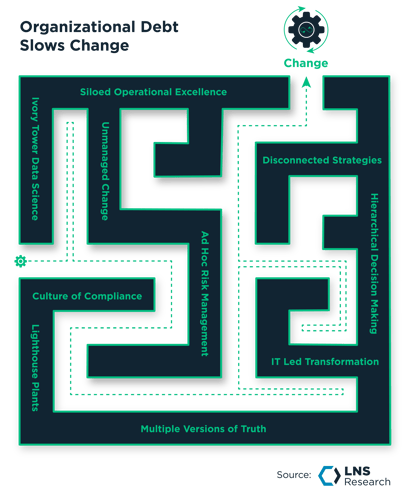
Figure 1: Trust is the hidden element of Organizational Debt
-
People Debt: When policies and leadership styles are grounded in 20th-century thinking, workers struggle to align with modern expectations. Lack of psychological safety, transparency, and respect creates resistance that no amount of technical training can overcome.
-
Process Debt: Siloed decision-making and rigid workflows prevent the kind of agility required for modern industrial responsiveness.
-
Technical Debt: Systems not built for speed or scale create friction, but even the best technical fixes are neutralized without trust in their intent.
Without trust, employees hesitate to engage, experiment, or speak up. Companies unlock a learning culture that activates engagement through Psychological Safety built on a foundation of trust.
Why Trust-Forward Organizations Win
LNS Research identifies “Productivity Pathfinders,” industrial companies with a 28.7% higher operating margin than peers, and notes that one of their core differentiators is building radical trust and transparency into their operations.
These leaders recognize that:
-
Workers in low-trust cultures see oversight tools as punitive. In contrast, high-trust environments allow data to be reframed as a driver of enablement, empowerment, and innovation.
-
Trust speeds adoption. Change initiatives fail when they lack resonance and clarity, both of which are byproducts of trust-based leadership.
-
Embedded trust systems, like transparent communications and psychological safety protocols, reduce resistance, accelerate learning, and improve resilience.
When we refreshed our research last summer on the state of adoption of advanced digital technology in manufacturing, research that we call the State of IX Tech, the results were dramatically different than even as late as 2023.
First, the cohort of leaders, those seeing significant results and dramatic improvement from their efforts, was the largest we have ever seen, at 28% of the population. These leaders exhibit several traits that suggest they have cracked the code on trust in their companies.
-
 Leaders report THREE times higher full trust in advanced and autonomous technology in their plants.
-
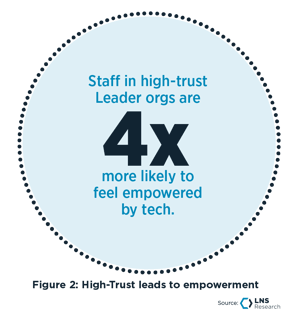
Leaders plant teams report FOUR times higher feelings of empowerment by adopting autonomous technology than followers, who are generally still fearful of job loss from technology (Figure 2).
-
Leaders are TWICE as likely to fully trust and act on insights generated from Advanced Analytics and AI tools and are THREE times more likely to be engaged in leading-edge AI Exploration compared to followers.
Best Practices of Trust Builders
At our IX Event in Chicago in October 2025, leaders from Unilever and Greif shared 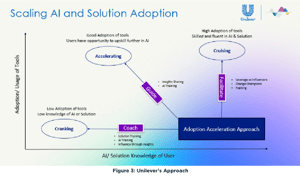 their approaches to trust-building that accelerated the adoption of advanced technology initiatives in their organizations.
Pratik Doshi from Unilever (Figure 3) shared his approach to segmenting his target audience into cohorts based on their affinity for the technology, then crafting targeted approaches to meet those people where they are.
Sara Clark, from Greif, (Figure 4) shared a compelling case in which she leveraged 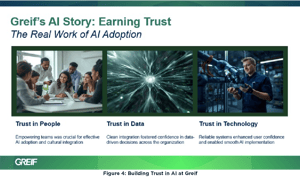 structured lessons learned, sharing, and celebrating the discovery of new knowledge to lower the perceived risk of experimenting and maybe failing in pursuit of new AI use cases in her company.
These practices of trust-building leaders reflect the key insights of the LNS Research Change Management Framework regarding responding to the realities of Diffusion of Innovation Theory and De-risking learning. (Figure 5)
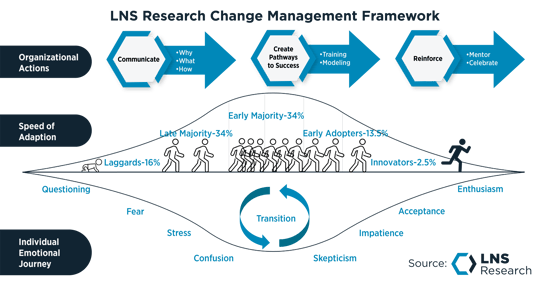
Figure 5: LNS Research Organizational Change Management Framework
Recommendations for Industrial Leaders
To operationalize trust as a requirement, not a hope, companies should do the following things:
- Design for trust from the start: Incorporate feedback loops, psychological safety, and narrative framing in every transformation initiative.
- Communicate intent clearly: Ensure every worker understands the “why,” “what,” and “how” of change. Use storytelling to position change as a collective opportunity.
- Reinforce behavior, not just outcomes: Model desired behaviors through leadership, mentoring, and recognition, aligning with the Diffusion of Innovation theory.
- Leverage structured learning: Adopt consistent post-mortem and lesson-learned processes that depersonalize failure and derisk experimentation.
- Rethink knowledge systems: Architect for agility by modernizing systems to match today’s pace, experience gaps, and complexity.
Final Thought
Industrial transformation will not succeed on technology alone. Shiny objects always lose their luster. Trust is the design criterion too many leaders overlook, and the hidden variable behind most failed change efforts. If a leader has trust in the organization, AI is viewed as an enabler and productivity tool, and is scaled as the organization demands more. If a leader lacks trust in the organization, AI is viewed as a threat and is stonewalled by the organization. When trust is present, resistance becomes resilience. When it’s absent, even the best strategies fall flat. Trust, earned early, deeply, and authentically, isn’t just a value. It’s infrastructure.