Operational Excellence
Maximo and Predictive Maintenance and Quality: The APM Arm of IBM
LNS Research explores the Asset Performance Solution, Maximo, offered by IBM.

Defining the Industrial AI category for prescriptive maintenance and asset reliability
Predictive maintenance has a long heritage in industrial analytics. Every technology wave since World War II has treated it as a proving ground to score quick wins before committing to a broad initiative. And for good reason: maintenance can account for as much as 20% of operating costs in the largest industrials, and unplanned downtime is one of the most visible failures on the shopfloor.
Over the past two decades, three generations of technology have chased the same promise: predict failures before they happen and keep assets healthy. One of my past blog posts on the evolution of predictive maintenance walks through that progression in detail, from Asset Performance Management (APM) to Advanced Analytics to Asset Intelligence.
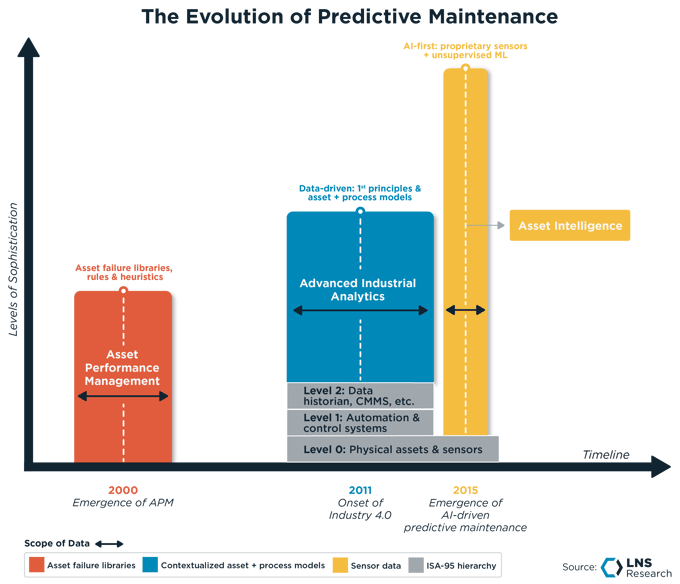
In this post, we will formally define Asset Intelligence as an emerging Industrial AI category, take a close look at its features and functionalities, and list qualified vendors we will assess as part of the upcoming Solution Selection Matrix™ (SSM).
Across the globe and sectors, Asset Intelligence is becoming a core capability for maintenance and reliability teams at some of the forward-looking organizations. Some of the largest enterprises, like Air Liquide, Danone, Georgia-Pacific, Indorama Ventures, JSW Steel, PepsiCo, Unilever, Whirlpool, Worthington Steel, etc., along with mid-size manufacturing companies like INX International, Kerry Group, and Scotts Miracle-Gro, etc., have leveraged Asset Intelligence to push boundaries of their predictive maintenance programs.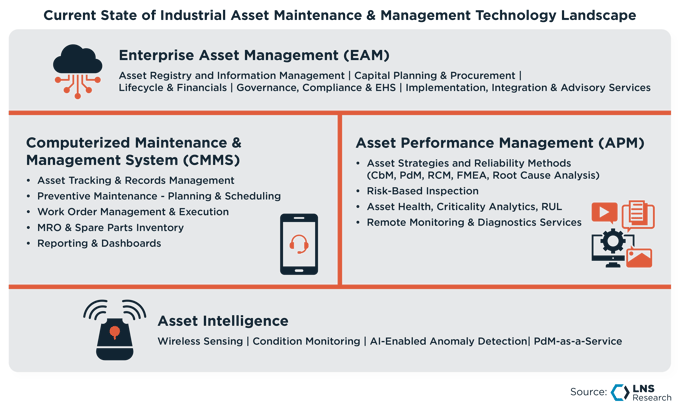
It is, however, one piece of a larger asset optimization landscape. My recent post on asset management technology landscape lays out how Computerized Maintenance Management Systems (CMMS), Enterprise Asset Management (EAM), Asset Performance Management (APM), and Asset Intelligence relate to one another. The likely end state is convergence toward a small number of AI-native systems that interoperate in ways previous generations could not. For the short- to medium-term, though, the landscape includes all four, and it is imperative for the industrial user and buyer community to understand where each fits.
LNS Research defines Asset Intelligence as the application of Industrial AI — machine learning, statistical analysis, physics-based and first-principles modeling, reliability engineering, and signal processing — to continuously monitor the health of large-scale production assets and convert that insight into prescriptive action in a closed loop.
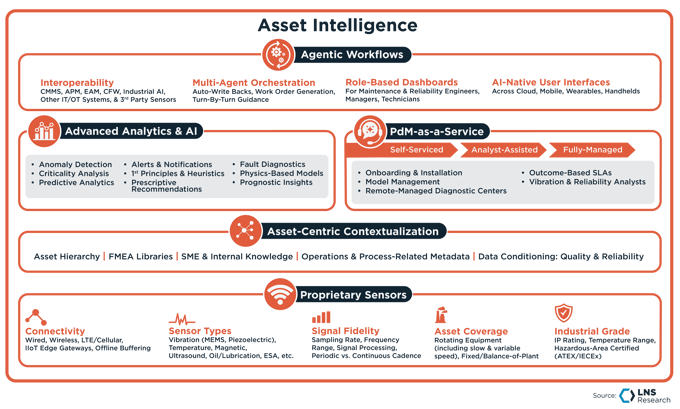
Delivering that end-to-end requires more than vibration monitoring or anomaly detection, and as a result, AssetIntelligence offerings combine hardware, software, and services.
Proprietary sensors. The hardware layer is an industrial-grade sensing network and should not be confused with the many vibration sensors on the market that perform only condition monitoring. Asset Intelligence sensing goes well beyond vibration to include temperature, magnetic flux, ultrasound, and thermal modalities at a broader range of signal fidelity. The sensors are certified for harsh environmental conditions and cover slow-speed, variable-speed, and non-rotating assets, not just standard rotating equipment.
Software. The software layer is built around a core analytics engine, but the engine alone is not enough. It needs unsupervised machine learning to detect anomalies; supervised models trained on labeled failure modes to estimate severity and lead time to failure; and asset contextualization that draws on more than just a namespace: maintenance history, operating context, and asset criticality all feed the model.
Services. Servitization in the industrial software space has found a warmer reception recently, and Asset Intelligence is positioned to benefit from the productivity and workforce pressures driving it. Certified vibration analysts on demand, remote diagnostics and managed monitoring, and outcome-based commercial terms are part of the offering. This is a meaningful difference from previous generations, and a large part of why it works where they did not.
Making all of this work requires an AI-native approach to workflows, well beyond a preferred integration with one or two CMMS or EAM systems. The direction of travel is automated work orders, real-time support for technicians, and fully closed-loop maintenance. It also requires new metrics. Potential downtime should be avoided, and decision latency should be considered alongside traditional reliability measures when evaluating these solutions.
Serving this market are a couple of different types of vendors, each with its own strengths and unique approaches. Let’s take a look at each of them:
APM incumbents: First, we have the juggernauts of industrial asset maintenance technology. ABB, Emerson, Honeywell, Siemens, and their peers have coverage across most layers of an Asset Intelligence solution. Honeywell's Versatilis sensors under Forge, ABB's Smart Sensor with Genix, Emerson's AMS sensors with its machinery health services, and Siemens' SITRANS sensors with Senseye are examples of qualifying offerings that stand on their own. Where that is the case, we will include the offering and identify the provider as an incumbent.
Purpose-built Asset Intelligence providers. The next set of vendors is arguably what defined this category, with state-of-the-art wireless sensors, sophisticated machine learning and AI models, and cloud-native analytics engines, and service models as one Asset Intelligence solution from the start. With no installed base to protect and no legacy architecture to carry, companies such as Augury, Tractian, Infinite Uptime, Nanoprecise, KCF Technologies, I-care, AssetWatch, and Waites are the primary players in this category.
Condition-monitoring specialists. The third group predates the Industrial AI era. A subset, Fluke Reliability, among them, is directly relevant to the Asset Intelligence discussion and qualifies. Most are specialists in a single sensing modality, such as Samotics with electrical signature analysis, Dynamox, and Petasense. Their heritage is anomaly detection on their own hardware, and whether they qualify depends on how far their analytics and service layers have climbed past that floor.
APM vendors whose asset health offering is software and services on a customer's existing data are a different matter. GE Vernova's SmartSignal, Aspen Mtell, and Falkonry are strong products that solve different problems, and they are assessed in the Advanced Analytics, Industrial AI platforms, or APM 4.0 SSMs, where they are most relevant.
Over the next few weeks, LNS Research will launch the Industrial AI: Asset Intelligence Solution Selection Matrix™, which will assess a qualifying subset of the vendors listed above in this category. The assessment will be done using the LNS Research 3P Evaluation Model, which scores Product against the framework above, Potential to grow and sustain the business, and Presence as proven reach across industries, geographies, and customer sizes.
Asset Intelligence is an important category of Industrial AI, and not just because it rides the AI wave. The AI buzz certainly helps, but more importantly, Asset Intelligence emerged as a category because it addressed gaps and provided effective solutions in ways previous generations of technology couldn’t.
APM was built on the physics of failure, but could not follow a fault through the tangle of interacting variables. Advanced Analytics could follow the tangle but was constrained by data that was rarely captured at the right fidelity and by constant training of models. Asset Intelligence brings the piece both were missing: purpose-built sensing that captures the signal at the source, and a service model that turns it into a decision faster.
Maintenance and reliability leaders would be well served by assessing where their programs stand today and making Asset Intelligence a deliberate part of their Industrial AI initiatives, rather than a side project run by the maintenance team alone. Here are a few recommendations to get started:
Predicting failure is only half the job: Today's maintenance teams do not suffer from a lack of data; dashboard fatigue is the real productivity killer. The companies that have successfully tackled this threat have done so through prescriptive maintenance.
Use deterministic guardrails to gain trust in AI recommendations: As a corollary to the previous statement, prescriptive maintenance provides greater value but carries higher risk. A false positive on a dashboard wastes an hour, but a false positive that becomes a work order wastes a crew, a part, and a production window. Deterministic guardrails and AI governance programs, including human-in-the-loop workflows and safe operating envelopes, are the support systems here.
Find the root cause of hardware resistance and design around it. It is common for additional hardware, such as sensors, to meet real pushback, especially when IT and corporate have to be involved in the network and security review. A significant portion of Asset Intelligence's value proposition comes from purpose-built sensing and the insight delivery built on top of it. Instead of rejecting RFPs because it needs new hardware, understand what is actually driving the objection and make a compelling case.

LNS Research explores the Asset Performance Solution, Maximo, offered by IBM.
Every year LNS Research puts forth predictions around the key trends in the Industrial Transformation (IX) topics where we focus our research. Here's...
LNS Research explores the Massachusetts Bay Transportation Authority (MBTA) maintenance plans proved to be poor and inefficient from the previous...